| click here for the |
| front page |
| features |
| fire lookouts |
| flytying |
| beavers |
| craters of the moon |
| arts |
| peter woytuk |
| printmaking |
| handmade guitars |
| living |
| high desert gardens |
| pavers |
| summer fitness |
| recreation |
| skateboarding |
| danny thompson mem |
| galena |
| dining |
| salads |
| margaritas |
| calendar |
| summer 2003 |
| to-do |
| sun valley essentials |
| listings |
| galleries |
| dining |
| lodging |
| fitness |
| golf |
| equipment rentals |
| outfitters + guides |
| maps |
| ketchum street map |
| sun valley street map |
| local art galleries |
| Galena summer trails |
| fire lookouts: Idaho |
| fire lookouts: locator |
| the guide |
| last winter |
| advertising |
| about us |
| copyright |
| Copyright
© 2003 Express Publishing Inc. All Rights reserved. Reproduction in whole or in part in any form or medium without express written permission of Express Publishing Inc. is strictly prohibited. |
| Produced
& Maintained by Express Publishing, Box 1013, Ketchum, ID 83340-1013 208.726.0719 Voice 208.726.2329 Fax info@svguide.com |
| The
Sun Valley Guide is distributed free twice yearly to
residents and guests throughout the Sun Valley, Idaho resort area
communities.
Subscribers to the Idaho Mountain Express will receive the Sun Valley Guide inserted into the paid edition of the newspaper. |

'Two
Gun Bob' & the Craters of the Moon
A place of color and
silence
by Mike
Medberry
From a high point behind the visitor center between Carey and Arco, the Craters of the Moon lava fields stretch beyond the nearer cinder cone mountains into infinity. The black lava seems to cover everything for as far as a person can see, as the horizon bends around to the south. Somehow it beckons. It is uninhabited land where promoters, like Robert Limbert, went in older times dreaming of what is beyond. Limbert was a man who worked diligently for the protection of the Craters of the Moon National Monument. Craters of the Moon was designated in 1924 as a 54,400-acre National Monument by a Proclamation of President Calvin Coolidge, and it was expanded by 661,287 acres by President William Clinton in 2000. This stunning expansion owes its original vision to Limbert.
 Limbert
wrote a National Geographic article in 1924 after traversing the wicked
lava country on foot at least three times, and he lobbied the idea
successfully in the halls of Congress. Congressman Addison Smith, from
Idaho, took up the Craters of the Moon monument notion and talked
Interior Secretary Hubert Work into getting President Coolidge’s
support.
Limbert
wrote a National Geographic article in 1924 after traversing the wicked
lava country on foot at least three times, and he lobbied the idea
successfully in the halls of Congress. Congressman Addison Smith, from
Idaho, took up the Craters of the Moon monument notion and talked
Interior Secretary Hubert Work into getting President Coolidge’s
support.
“No more fitting tribute to the volcanic forces which built the great Snake River valley could be paid than to make this remarkable region into a National Park or Monument,” Limbert claimed in an early version of the National Geographic article.
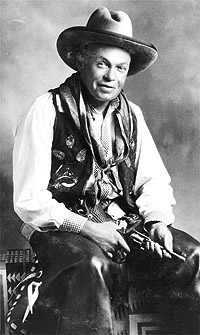
“Two Gun Bob,” as Limbert was known in the ’20s and ’30s, was a flamboyant character and lively storyteller. He made his living as a gunslinger—he would shoot a silver dollar as it flew or hit a sharp axe blade, splitting a bullet to smash a plate on either side—as he toured the East in a Wild West show. Once he claimed to challenge A1 Capone, the infamous criminal, to a shootout. Capone refused to take him up on that challenge, and Limbert used it to publicly display his toughness.
“He was a total raconteur,” said John Davidson, who ran Grainey’s Pub in Boise and has known about Limbert for many years. “He spoke for the wonders of Idaho. I guess you could say he was an early day conservationist. Compared to Borah (U.S. senator from Idaho, serving 1907-1940), who saw a forest as something to use up and sell, Limbert saw something to protect. He brought awareness and a commitment to keep something intact. He saw Idaho’s real treasures: the beauties of place that make people want to come to it from all over.”
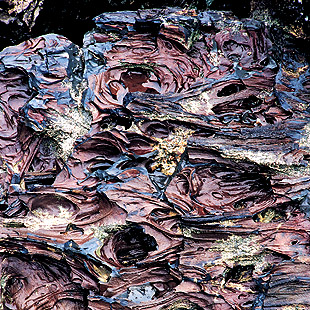
In 1911, Limbert came to Idaho from Nebraska to start a taxidermy business, and in 1920 he was one of the first white men to traverse the Craters of the Moon lava fields. He wrote kindly of Craters in the National Geographic article as having “bubbles, rolls, folds, and twists as if a giant’s frying pan of thick gravy furiously boiling had been frozen instantly.”
 Limbert
knew a good name when he saw it. Geologist H. T. Stearns once wrote that
this area was similar to “the surface of the Moon as seen through a
telescope.” That was the idea that stuck, and Limbert used it to best
advantage in the National Geographic article.
Limbert
knew a good name when he saw it. Geologist H. T. Stearns once wrote that
this area was similar to “the surface of the Moon as seen through a
telescope.” That was the idea that stuck, and Limbert used it to best
advantage in the National Geographic article.
The terrain he braved on his hikes was aa lava, a Hawaiian word that roughly means “hard to walk on.” It is a rubble of sharp, broken pieces of lava. Pahoehoe lava, meaning “ropy coils,” is easier walking terrain.
He wrote, and Limbert was a prolific writer, that, “It is also a place where one wants to feel free from human interference, to be able to gaze and feast their eyes on the scene spread out below without being molested.”
However, the most beautiful sight he saw was the Blue Dragon Flow.
“It is the lay of light at sunset across this lava that charms the spectator,” Limbert wrote. “It becomes a twisted, wavy sea. In the moonlight its glazed surface has a silvery sheen. With changing conditions of light and air, it varies also, even while one stands and watches. It was a place of color and light.”
And Craters of the Moon was a place he thought was going to be an enormous tourist draw, a place “destined to some day attract tourists from all of America.”
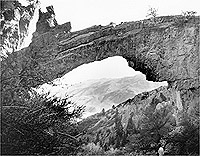
It didn’t turn out that way, despite Limbert’s forward thinking. But it wasn’t for failing to tell the stories of stunning caves, surprising arches, cinder cones and waterholes, abundant wildlife, and flowers that bloom in late April and May, or of the diverse lava flows and kipukas, the grassy areas surrounded by lava. These remain out there for anyone to explore.
Former Secretary of the Interior Bruce Babbitt came out to the Craters in 1999, and while hiking beyond the existing monument, he saw the potential for the rest of the lava flows and a 50,000-acre kipuka called Laidlaw Park being protected. That was formed by a 1990 study by the Park Service: “Expansion of Craters of the Moon Monument.” He gave his proposal to President Clinton, and Clinton designated the larger 661,287-acre area as a National Monument on Nov. 9, 2000.
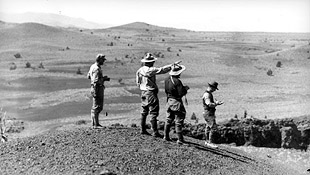
That second Proclamation stated, among other things, that “The kipukas provide a window on vegetative communities of the past that have been erased from most of the Snake River Plain ... As a result, the kipukas represent some of the last nearly pristine and undisturbed vegetation in the Snake River Plain, including 700-year-old juniper trees and relict stands of sagebrush that are essential habitat for sensitive sage grouse populations ... The most recent eruptions at the Craters of the Moon took place about 2,100 years ago and were likely witnessed by the Shoshone people, whose legend speaks of a serpent on a mountain who, angered by lightning, coiled around and squeezed the mountain until the rocks crumbled and melted, fire shot from the cracks, and liquid rock flowed from the fissures as the mountain exploded.”
Without the dogged ambition Limbert had asserted more than half a century ago, this proclamation to protect a total of 715,000 acres would hardly have been possible.
But a place that people have long since forgotten now is being discovered. More than 200,000 people per year drive by and wander into the visitor’s center. Superintendent of the Craters of the Moon, Jim Morris said that in the winter “you have the sense of solitude because there are no snowmobiles and not many people. With the white snow and the black rocks it is a wonderful scene. This is an undiscovered place in wintertime.”
A story about Limbert is incomplete if it fails to mention that he built the Redfish Lake Lodge, a popular summer resort 50 miles northwest of the Sun Valley area.
“He finished it in 1931 or 32, before he died in 1933,” says Margaret Lawrence, Limbert’s 86-year-old daughter and a first-rate troublemaker in her own right. “But I remember that he enjoyed whistling to the crank-up phonograph and driving over Galena summit pulling a log to slow down. And I remember spending every summer there and that we had one of the first Ford station wagons.”
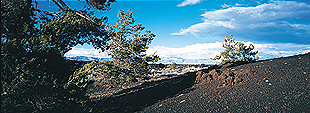
Limbert was an outfitter, an ardent sportsman, and took thousands of photos of the Owyhee Canyons. He prepared the Panama-Pacific Exposition on Idaho, and he was a writer of short stories and a few poems. In particular, his photos of the Owyhee documented structures and the range conditions that have since been obliterated beyond recognition. Limbert’s pictures show the Owyhee Canyons with abundant grasses and the Snake River with the Shoshone Falls running free; they show the Indian Bathtub springs that now hardly run, and today they are habitat for endangered snails.
Limbert documented all of this by accident, of course, but it is irrefutable evidence of ensuing short-term impacts of careless use of the values he cherished. He died young, at the age of 48, from a brain hemorrhage on the way to visiting his dying mother.