| click here for the |
| front page |
| features |
| stanley, idaho |
| bronc riding |
| broadford riot 1885 |
| fighting fires |
| arts |
| three jewelers |
| custom saddles |
| living |
| kitchen design |
| pilates |
| recreation |
| white water fun |
| sporting clays |
| names of the peaks |
| summer trails |
| summer a to z |
| dining |
| seafood in the mtns |
| calendar |
| summer 2002 |
| listings |
| galleries |
| outfitters & guides |
| fitness |
| tennis |
| golf |
| property mgmnt. |
| lodging |
| dining |
| maps |
| ketchum+sun valley |
| summer trails |
| KART bus map |
| the guide |
| last winter |
| advertising |
| about us |
| copyright |
| Copyright
© 2002 Express Publishing Inc. All Rights reserved. Reproduction in whole or in part in any form or medium without express written permission of Express Publishing Inc. is strictly prohibited. |
| Produced
& Maintained by Express Publishing, Box 1013, Ketchum, ID 83340-1013 208.726.0719 Voice 208.726.2329 Fax info@svguide.com |
| The Sun Valley Guide is distributed free twice yearly to residents and guests throughout the Sun Valley, Idaho resort area communities. Subscribers to the Idaho Mountain Express will receive the Sun Valley Guide inserted into the paid edition of the newspaper. |

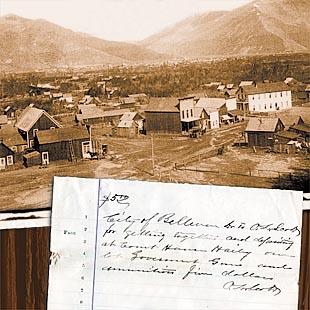
Broadford Riot of 1885
by Peter Boltz
It was an innocuous enough report in the newspaper.
“The boys began coming yesterday.”
More than 100 miners came to Bellevue, formed up in procession and moved on the mining town of Broadford on St. Patrick’s Day, 1885.
“All day and evening, teams brought down their human freight from Bullion, Deer Creek, Ketchum and the surrounding gulches,” the Wood River Times reported.
The miners had come to Broadford to show their solidarity with the Broadford Miners Union and join the fight if a fight should break out. The day before, the paper reported that the union intended to take the Minnie Moore and Queen of the Hills mines by force of arms.
It “had secured all the arms obtainable and numerous delegations of miners from the upper county,” the paper said.
In response to the threat, Alturas County Sheriff Charles Furey (Alturas County was later divided, and Bellevue became part of Blaine County, as it is today) distributed 60 Winchester rifles and ammunition to his deputies guarding the entrances to the mines. The rifles were sent to the city of Bellevue by acting Territorial Gov. E.J. Curtis to put down any violence, should it erupt.
So the stage was set for a bloody St. Patrick’s Day, when miners who had come down from the north joined with miners living in Bellevue to
march into Broadford to support their union brothers.
In 1885, Broadford was a busy town
of boarding houses, residences, businesses and saloons, thanks to the discovery in 1880 of silver up the Minnie Moore Gulch.
Today, Broadford isn’t even a ghost town, at least not a ghost people can see.
When people talk about Broadford today they refer to a neighborhood not a town, a stretch of Broadford Road from Bellevue’s North Main Street to the Church of Jesus Christ of Latter-day Saints in Hailey.
The most visible evidence of the town of Broadford is not a ramshackle building or two, but a pile of mine tailings that can be seen soon after driving north on Broadford Road from Bellevue.
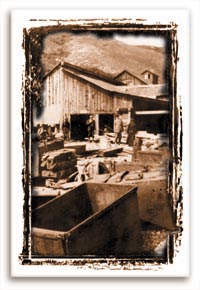 The tailings pile—from the Minnie Moore’s sister mine, the Queen of the Hills at the mouth of Minnie Moore Gulch—is on the western edge
of Broadford.
The Broadford Road of today runs approximately through what was the center of Broadford.
Folklore has it that silver was discovered up Minnie Moore Gulch by a badger on some unknown date and that Daniel Scribner discovered the badger’s discovery in 1880.
He set out from Bellevue one December day, after being grubstaked by his partner, J.W. Moore. He passed through Broadford and set up camp at the mouth of the gulch.
During the night, his horses strayed up the gulch, and next morning, while Scribner was searching for them, he found a badger hole.
Or, as another account has it, his dog chased a rabbit into an empty badger hole.
When he examined some of the rocks the badger had dug out, Scribner found galena, a lead ore containing silver. With a little digging of his own, he found a vein of galena rich in silver.
Within a week, Scribner sold out for $11,500, at a time in American history when factory workers were making about $10 a week.
Moore sold his half in August 1881 for $50,000.
The mine produced 22,047 ounces of silver in 1881, 10 times that in 1884 and nearly half a million ounces in 1886.
In 1880, silver was worth $1.50 an ounce. It fell to $1.14 by 1884 and 10 years later, a year into the nationwide depression of 1893, silver was worth 59 cents an ounce.
The value of silver began its slide years before when, on Sept. 20, 1873, the New York Stock Exchange suspended trading for 10 days, and many of the nation’s banks suspended operations because their reserves were seriously low.
These events have come to be known collectively as the Panic of 1873.
Several factors contributed to the strain on the money supply: post-Civil War inflation, speculative investment in railroads, a large trade deficit
and significant property losses in the Chicago and Boston fires of 1871 and 1872.
Compounding the problem of low bank reserves was the fact that the federal government had funded its war effort in 1862 by printing “greenbacks,” paper money backed only by the authority of the government. In short, the United States went off the gold standard.
By the end of the Civil War, $450 million in greenbacks were in circulation, which inflated the dollar beyond what gold the federal government had in its treasury.
Another event in 1873 added to the country’s economic problems.
The Coinage Act of 1873—also known as the Crime of 1873—was an attempt to deal with the inflation by returning the country to the gold standard and ending the production of the silver dollar by the U.S. Mint.
“Hard money” advocates welcomed the return to the gold standard because they believed it stabilized the money supply and so strengthened the economy.
“Soft money” supporters wanted an inflated dollar to help debt-ridden farmers.
With an inflated dollar, the value of farmers’ debts would decline because their crops would bring more dollars while their debts would remain at the same dollar amount.
The soft or “cheap” money advocates first tried to convince the government to continue flooding the money supply with greenbacks, but when this didn’t work, they changed their tactics.
Perhaps the federal government would go for the unlimited coining of silver. After all, silver was a “precious” metal and had been part of a U.S. bimetal standard with gold.
And so was born the “free” silver movement—the “free” meaning unlimited coining.
Silver mine owners and miners also liked the idea because worldwide markets, including the U.S. government, were drying up in the early 1870s, sending the price of silver down.
Before the Coinage Act, they had a ready and easy market for their silver in the U.S. Mint, where they deposited it for conversion into silver dollars, which had an equivalent value in gold.
The silver kept its value, because law set its equivalent in gold.
The Coinage Act ended this market.
For American farmers, the Panic and the Crime of 1873 led to a deflation of the dollar, which increased the burden of their debts.
For silver mine owners, the events of 1873 meant a growing devaluation of their production.
For silver miners, the Panic and the Coinage Act meant the devaluation of their labor.
The prevailing daily wage for miners in the Wood River Valley was $4, but with the fall of the price of silver, and lead too, mine owners were looking to cut costs.
In July 1884, the new owner of the Minnie Moore Mine, the English firm of Dent, Palmer & Co., cut the wage from $4 to $3.50. The Queen of the Hills Mine soon followed suit.
With this, the Broadford Miners Union called a strike.
In response, the two mines started using “contractors,” who had to be escorted to work by sheriff’s deputies after several were assaulted by union men who considered them scabs.
Typically these assaults were verbal. The union men would argue with contractors and try to win them over, but there were also incidences of beatings and threats with firearms.
A couple of contractors were forced to kneel at gunpoint and swear they would not return to the mines.
These acts and others excited rumormongers to circulate stories about the union, like one about
miners planning to dynamite the city of Bellevue.
In response, Bellevue citizens banded together and formed a “committee of safety” to patrol and guard the city.
The president of the Broadford Miners’ Union, Barney McDevitt, didn’t help calm fears when he declared in Broadford on the day of the riot that “blood would run in the streets of Broadford and Bellevue.”
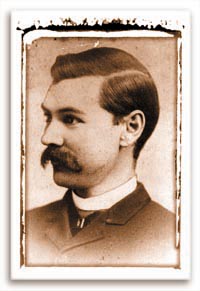 Only Sheriff Furey and his deputy and brother, Pat Furey, stood between the angry miners and the road to the mines that St. Patrick’s Day.
Different witnesses estimated the mob to be between 200 and 400 men who threatened to head to the mines and forcibly remove the contractors working in them.
Twice they almost crossed the “dead line.” This was just a trench to run water to a hotel. But on the 17th, someone started calling it the dead line, where the Furey brothers stood between the mob and the mines.
The brothers never said they’d kill anyone crossing it, but Pat Furey did tell them “they would regret it” if they did.
Luckily, the Furey brothers and many of the miners were coolheaded, and a deal was struck that defused the threat of mortal violence.
A delegation of union officials were escorted to the two mines by the sheriff, and after, the sheriff sent all the contractors home.
The mob dispersed.
That night the sheriff telegraphed Gov. Curtis and U.S. Army Gen. James S. Brisbin, asking for troops.
The two arrived next morning without troops, but just the threat of military intervention broke the union’s back.
Several miners, including McDevitt, were arrested on the charge of riot, but none of the charges stuck and all got off with fines.
Within two months of the “riot,” the union was dissolved, and $3.50 became the going daily wage.
King Silver was dead, and everyone knew it. •
Thanks to Chris Millspaugh of the Regional History Department of the Community Library, Melanie Dahl of the Bellevue Museum, the Hailey Library and the Idaho State Historical Society.