| click here for the |
| front page |
| features |
| stanley, idaho |
| bronc riding |
| broadford riot 1885 |
| fighting fires |
| arts |
| three jewelers |
| custom saddles |
| living |
| kitchen design |
| pilates |
| recreation |
| white water fun |
| sporting clays |
| names of the peaks |
| summer trails |
| summer a to z |
| dining |
| seafood in the mtns |
| calendar |
| summer 2002 |
| listings |
| galleries |
| outfitters & guides |
| fitness |
| tennis |
| golf |
| property mgmnt. |
| lodging |
| dining |
| maps |
| ketchum+sun valley |
| summer trails |
| KART bus map |
| the guide |
| last winter |
| advertising |
| about us |
| copyright |
| Copyright
© 2002 Express Publishing Inc. All Rights reserved. Reproduction in whole or in part in any form or medium without express written permission of Express Publishing Inc. is strictly prohibited. |
| Produced
& Maintained by Express Publishing, Box 1013, Ketchum, ID 83340-1013 208.726.0719 Voice 208.726.2329 Fax info@svguide.com |
| The Sun Valley Guide is distributed free twice yearly to residents and guests throughout the Sun Valley, Idaho resort area communities. Subscribers to the Idaho Mountain Express will receive the Sun Valley Guide inserted into the paid edition of the newspaper. |

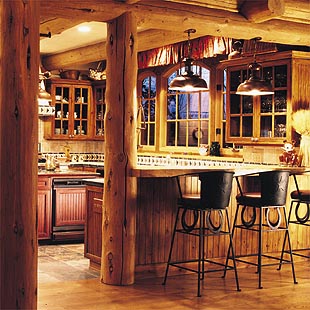
The Heart of the Home
By Dana DuGan
Come into my kitchen, where the aromas are complex, light is mutually beneficial and flattering, colors are retro-modern and the gadgets appear sleek and practical.
Or is your preference an old-style country kitchen? There, sunshine bathes the rough-hewn terra cotta and woodwork; the commodious sink holds fresh-grown produce, and the smell of just-baked bread wafts through gingham-curtained windows.
Whatever your fancy, the kitchen remains the favored place to congregate in a home. To have one is to live in one.
Originally the kitchen was, by necessity, the center of the dwelling. Hunters, fishermen, farmers and merchants spent precious time with
their families over many a meal. It was the center of the home with the hearth, the warmth and the food. Breaking bread together was, and continues
to be, a natural expression of man’s instinctual sociability. The kitchen was not just home to the fireplace and work area, it had the best light and was the hub of family life.
In the 1920s and 1930s, the arts and crafts movement and Frank Lloyd Wright’s design approaches encouraged more open and inclusive living areas.
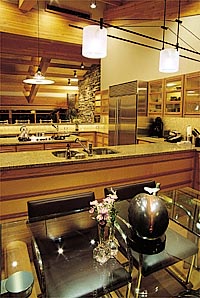 A few decades later America was immersed in the cookie-cutter postwar era. Men were back at work and dream kitchens were the little woman’s domain. The power of American technology supplied handy appliances and gadgets to make her life easier.
“Now, what I see,” said architect Dale Bates of Living Architecture in Ketchum, “the kitchen is coming back as the center of the home.”
Bringing people into the kitchen, making guests and family members part of the culinary experience, even if it’s just shared space, has become one of the most vital elements of contemporary home design.
Along with the help of a feng shui practitioner Peggy Doscher, Bates is considering each kitchen he designs as a whole space, one that works integrally with his client’s lifestyle. Often this means the kitchen is a bigger room, co-opting space from
the underused living room, and eliminating a formal dining room all together.
To achieve that synergy, Bates relies on lighting, materials, colors, seating, workspaces and the all-important flow. Flow is the art of making maximum use of the space without blocking traffic.
Since the stove is the modern-day version of the hearth, it should be accessible, said Bates. And, ideally, the placement of the stove should allow the cook to face the room. Skylights, greenhouse windows and eastern exposure are all integral to a workable, inviting kitchen.
“Separate workspaces for cleaning, cooking, eating and just sitting conform to the idea of the kitchen as many things to many people,” said Bates.
Materials are vital in incorporating the kitchen into a true living area. Bates recommends radiant heated concrete floors with padded canvas, jute, hemp or sisal area rugs to soften them. New linoleum made from cork and wood flour is easier to stand on and non-toxic—a factor Bates considers important.
Doscher adds that commonly seen details like knives on magnetic strips, bright lights and sharp corners can be an unconscious turn-off to people. Rounded edges, accessible seating areas, pots stored and appliances hidden are all conducive to creating a comfortable, efficient kitchen.
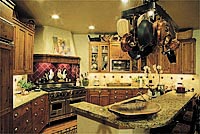 While Bates adheres to a mostly muted earth-tone palette, color forecasters say this year’s colors are botanical greens and blues. The newest yellows are inspired by the organic qualities of fruits,
vegetables and grains. Colors drawn from nature are a counterbalance to the latter-day
technology-induced sensory overload.
While Bates adheres to a mostly muted earth-tone palette, color forecasters say this year’s colors are botanical greens and blues. The newest yellows are inspired by the organic qualities of fruits,
vegetables and grains. Colors drawn from nature are a counterbalance to the latter-day
technology-induced sensory overload.
Which brings us to harmonizing materials: wood, earth, water, metal and fire. Commingling these elements integrates a kitchen into a space where everybody feels at home.
Architect Tobin Dougherty, who works locally and in Palo Alto, Calif., agrees: “It’s about having the right amount of comfortable space to have a good working plan to accommodate all the people—cooks, family, friends, children—without tripping over each other. Interacting but not getting in each other’s way.”
Dougherty designed a prototype of the “new intelligent” kitchen in the November 2000 issue of Good Housekeeping. He utilized contemporary finishes in a traditional and functional layout, while introducing other ideas that are born of convenience and comfort, such as dual dishwashers installed like drawers on either side of the sink and set higher to protect shins, and a central food preparation area.
“The coolest kitchens can sometimes have trade-offs, but kitchens can be too big, with too many steps between appliances and work areas,” he warned.
Solutions for combination kitchen rooms lay in some new-fangled ideas merged with updated old ones, such as separate coolers for produce, warming ovens and appliance garages which keep the works handy but without the counter clutter.
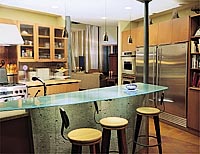 But where is your welcoming kitchen if there isn’t a spot for sharing a pot of tea, a glass of wine or a place to read the paper while one’s partner whips up the evening meal? Tables and counters come in a variety of heights and shapes. Counters can be rounded to make them more congenial, and tables might be anything from old worn oak to colorful 1940s porcelainized steel topped. Counter tops at islands should be the correct height for sitting or working, while kitchen designers say chopping and bread-kneading counters, for instance, should be of a lower height. Counters also break up the space between eating areas and work areas. In the new wave of counters, there are lower seating areas.
Some still prefer the bar style, which is conducive to parties, where both standing and sitting among the cookery is prevalent.
The spirit of a sociable kitchen is in the union of current technology with materials of the past. It’s also embedded in the hospitality of the contents and colors chosen to flavor your space. A bowl of fresh fruit and a fresh loaf of crusty bread can be
all the inducement one needs to enter and stay. •