| arts |
| william morris |
| theatre in the valley |
| magic in murals |
| woodworking |
| living |
| water gardens |
| recreation |
| summer trail picks |
| sun valley from a to z |
| dining |
| pure gourmet idaho |
| black pot magic |
| calendar |
| summer 2001 |
| maps (large) |
| heart of idaho |
| hike & bike trails |
| ketchum & sun valley |
| KART bus routes |
| the guide |
| front page |
| back issues |
| advertising info |
| about |
| Produced
& Maintained by Express Publishing, Box 1013, Ketchum, ID 83340-1013 208.726.0719 Voice 208.726.2329 Fax info@svguide.com |
|
Copyright
© 2001 Express Publishing Inc. |
|
The Sun Valley Guide is distributed free twice yearly to residents and guests throughout the Sun Valley, Idaho resort area community. Subscribers to the Idaho Mountain Express will receive the Sun Valley Guide inserted into the paid edition of the newspaper. |


| local listings |
| art galleries |
| equipment rentals |
| outfitters & guides |
| fitness centers |
| golf courses |
| tennis courts |
| property management |
| lodging |
| restaurants |











summer 2001 : features
Silver Creek—
Jack's Private Idahoby Ken Retallic
The siren call of Silver Creek haunts the dreams of fly fishers all over the globe. Once answered, it hooks them for life.
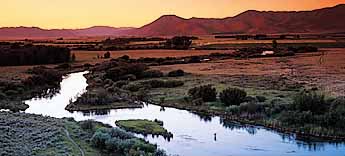
The Smoky and Pioneer Mountains to the north are dramatic backdrops for the creek Field and Stream magazine once called the finest dry fly stream in America. A classic view engraved in the minds of many by a half century of photographs in magazine articles is from the narrow gravel road carved into a slope of the Picabo Hills directly above its headwaters. Below, the fabled stream etches a silvery ribbon through a serpentine band of green traversing the broad bowl of the lower Wood River Valley.
Silver Creek is a quintessential spring creek. It rises from cold aquifers at the Bellevue Triangle, below the place where the Big Wood River was forced to veer west away from its former streambed by ancient lava flows. The cool crystal-clear waters now bubbling from watercress-lined springs into boggy, weed-laden Stalker and Grove creeks merge to form Silver Creek. About two miles downstream, Loving Creek adds its crisp flows to the main channel near the eastern edge of the old Sun Valley Ranch, now known as the Silver Creek Preserve. It then meanders unhurried through cattle ranches, swings around the hamlet of Picabo, and glides past alfalfa, barley and potato fields before carving its way through desert sagebrush and lava outcroppings to join the Little Wood River, south of Carey.
Despite fluctuations of weather and changes in land use, Silver Creek’s cool water temperature and nutrient-rich clarity remain relatively constant. Such conditions are nearly perfect for producing abundant crops of aquatic insects and crustaceans necessary to grow large trout, and Silver Creek lives up to its potential.
But, except for the fly fishing infatuations of a teen-age son of a famous author, it might have been lost.
The young Jack Hemingway was champing at the bit to test his mettle against Silver Creek’s celebrated rainbow trout when he finally reached Idaho late in the summer of 1940.
“Sun Valley was like paradise lost,” he wrote in his autobiography— Misadventures of a Fly Fisherman. “Papa’s letter of the previous fall had in no way exaggerated.”
The letter, written during Ernest Hemingway’s first stay at Sun Valley, declared, “You’ll love it here Schatz … there’s a stream here called Silver Creek where we shoot ducks from canoe…Saw more big trout rising than have ever seen…Just like English chalk stream…We’ll fish it together next year... .”
The magical words for his eldest son were “big trout” and “English chalk stream.” And, ever since, numerous other writers have compared Silver Creek’s trout-laden flows to those hallowed waters— equally rich in minerals, aquatic insects and smart trout.
On a guided visit to the Sun Valley Ranch, Hemingway discovered “the creek was almost crystal clear at all times…There was a luxuriant growth of a wide diversity of aquatic plants, all of which made for ideal conditions for a great profusion of aquatic insects, scuds, shrimp, and snails.”
He acknowledged he was “thoroughly humbled” by its uncooperative rainbows. But, as a life-long devotee of dry fly fishing, he also was enamored with the intricate complexity of the stream’s prolific aquatic insect “hatches” and the delicacy of the tiny feather-and-fur “flies” he learned to use to fool the fish.
Many years later during a day of fishing Silver Creek with Ernest Schweibert, Hemingway told the noted fly fisherman and author that his father lost interest in fly fishing because a large trunk of rods and equipment was lost in transit, but his own infatuation never waned.
“Maybe I was looking for something I could do as well as Papa did it—and trout fishing on Silver Creek was the first thing I found,” he said.
But it took persistence. In a 1999 Idaho Mountain Express interview, Hemingway acknowledged, “It was years before I could catch fish there.
“It can be fairly easy if someone is telling you what’s going to happen and you have the right tackle. If you’re trying to figure it out for yourself, and you don’t know what’s going on, it’s as tough a place as any to catch fish. If a guy tells you that he went down to Silver Creek by himself and he caught fish, that guy can fish.”
Fortunately, he persisted and, in 1967, he returned with his family to live the rest of his life in Ketchum.
An acclaimed outdoorsman, conservationist and author, Hemingway died December 9, 2000. He was 77. Among the many accolades bestowed by family and friends at a memorial service in Sun Valley was appreciation of his role as “the savior of Silver Creek.”
“Idaho has lost one of its finest, and he will be truly missed. Jack Hemingway lived a life as big as Idaho’s outdoors. He was never happier than when he was knee-deep in the midst of one of our beautiful mountain streams, fly rod in hand,” said Gov. Dirk Kempthorne.
“Jack was a man who gave freely of himself, serving our country in World War II and serving Idaho as a Fish and Game commissioner in the 1970s. He left us an extraordinary legacy when he spearheaded the effort to preserve one of Idaho’s premiere trout streams, Silver Creek. And now, the clear waters of Silver Creek beckon fly fishermen from all over the world ... a living legacy to a remarkable man.”
In 1975 the Sun Valley Company, then owned by Bill Janss, put up for sale 479 acres along the creek’s finest stretch. Hemingway led a group of local sportsmen searching for a buyer to save their cherished creek and preserve public access to its fishery.
They went to The Nature Conservancy and convinced its leaders to buy the parcel. Hemingway enlisted Schweibert into the national fund-raising campaign and the Silver Creek Preserve was born.
Hemingway led the fight to make the preserve open to fly fishing only and to establish catch-and-release regulations. The Conservancy restored the banks and river conditions on the preserve under the leadership of Guy Bonnivier, of Ketchum, who retired last year as director of The Nature Conservancy of Idaho. But they didn’t stop there.
Leading by example, the Conservancy was able to convince many of its ranching and farming neighbors to place their lands into conservation easements that prevented development and improved the quality of Silver Creek. Today, more than 30 miles of Silver Creek and its tributaries and 9,195 acres of habitat is protected.
Once again, Silver Creek is the home of rainbow and brown trout up to 28 inches. Studies show it contains the highest density of trout of any wild trout stream in the United States —5,000 trout per mile.
In celebration of the preserve’s acquisition, Hemingway extolled its natural wonders in a 1976 Conservancy news article:
“There are red-winged blackbirds calling in the cattail marshes, geese clamoring on nesting sites ... bees are gathering pollen in the wildflowers, trout rising to early hatches, all mixed with the sound of the stream — the fishing regulars call it Silver Creek music.”
It was a theme he repeated numerous times over the years. A self-taught naturalist, Hemingway reveled in the beauty of nature and the bounty of its creatures.
My father, in an unconventional way, was a priest of sorts … in the greatest cathedral of all—nature,” Mariel Hemingway said during an emotional eulogy at the memorial service. “His communion took place in the streams and rivers he fished ... The peace that Daddy felt in the outdoors was a gift from God ... and he gave it back by his many conservation efforts, and in sharing with family and friends... .”
A green oasis in the sagebrush desert, the lush riparian shrubs and trees of the Silver Creek Preserve provide a haven for wildlife and birds. Among its cornucopia of wildflowers is the small yellow ladyslipper orchid, a state plant species of concern. As many as 150 species of birds have been identified along the self-guided nature trail, which begins at the preserve visitor center. Numbered signs along the nature trail are keyed to notes in a free guide about the preserve’s other ecological features. A bird check list also is available.
For many Wood River Valley residents and other visitors, the preserve is a favorite getaway to go bird watching, hiking, bird hunting and canoeing. Natural history walks led by the preserve’s staff are offered each Saturday throughout the summer. They begin at 9 a.m. from the visitors center. It is located 35 miles south of Ketchum and two miles east of Picabo.
This year marks the 50th anniversary of The Nature Conservancy and the 25th anniversary of Silver Creek Preserve.
“There wouldn’t be a Silver Creek if it wasn’t for Jack Hemingway,” Bonnivier said two years ago when The Nature Conservancy celebrated Hemingway’s contributions. “He also was a tremendous help and mentor. He’d stop in unannounced and visit, a real boost when were just getting started.”
But Hemingway also often pointed out that not all Silver Creek roads lead to the preserve.
“I don’t like fishing with a lot of people and it’s very popular,” he laughed. “So, I tend to go down to the public waters. Everyone wants to go to special regulation water. One of the things we’re trying to do is encourage people to move out and fish in more places than just on the Conservancy.
“There are big fish feeding throughout the system now. It’s no better in one place than another.”
Below Kilpatrick Bridge, the creek flows through the Purdy Ranch, a private section which requires coveted fishing access rights purchased by about 300 people. Float tubers or fishermen in canoes can float through but cannot go above the high water mark, which in this spring creek is basically the stream.
The Idaho Department of Fish and Game owns a large area known locally as Point of Rocks, which can be reached from the road that turns north at Picabo, or the road just west of where Silver Creek crosses Highway 20, west of Picabo. The Silver Creek Road, southeast of Picabo off Highway 20, goes to the only other public access site, four and one half miles south at the area known as Priest Rapids.
Outfitters and guides who work the stream tout it as “the graduate school of fly fishing.” It’s not impossible to catch them, but the trout have learned to ignore the hordes of fly fishers drifting flies through their lairs and continue to feed on the stream’s smorgasbord of aquatic and terrestrial insects.