

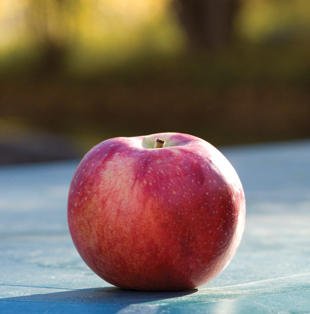
Idaho's forbidden fruit
Each autumn, cider presses are rescued from Wood River Valley cobwebs as neighbors gather for a seasonal tradition that has fallen casualty to modern life in most of America. Photographer Paulette Phlipot captures the sights while Michael Ames hunts the meaning of the modern American apple, right here in Idaho.
Driving Idaho’s interstates, you are unlikely to spot a single apple tree. Dairy farms, yes. Sod-covered potato huts rising out of flat farmland. Silver irrigation pivots, spraying arcs of water high over green crops. Tumbleweed. All this you will see from a window, riding along the Snake River Plain at 80 miles per hour.
Apple country, this is not.
Now take a meandering course
through the cottonwood-thick ravines and up-valley farms of Idaho’s gem
towns. Here, in the valley walls’ half-day shadows, between a fence and
a sidewalk, or just in somebody’s yard, are apple trees.
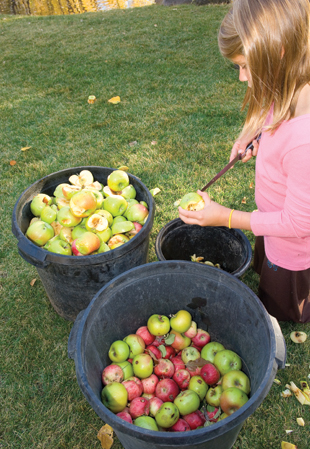
There are apples here because people have lived in these valleys for generations. More than old ranch stockades, more than gray, splintered ghost-town remains, apple trees mark human territory.
In his book, The Botany of Desire, Michael Pollan retraces the steps of John Chapman, aka Johnny Appleseed. Pollan learned that the inspiration for this storybook character was a real (eccentric) man whose traveling apple seed business helped transform large swaths of the Midwest in the early 19th century. This was the western frontier, and Chapman was instrumental in its "taming."
In that country at that time, Pollan reports, the law required settlers to plant "at least 50 apple or pear trees" on purchased land. "Since a standard apple tree normally took ten years to fruit, an orchard was a mark of lasting settlement."
At some point in the spread of Americans over their land, the question "Where will we plant our fruit trees?" ceased to arise. Maybe it was the upkeep, all those mushy, rotting red and brown blemishes on an otherwise manicured yard. Or maybe evangelism: What good Christian wants a constant reminder of the fall from grace?
But as the country grew, so did apple demand. Turns out, we didn’t stop planting trees—we consolidated. Neighborhood orchards begat regional farms that in turn yielded to corporate apple distributors.
Global food distribution helps
feed millions, but consolidation has its price. Pollan notes a shrinking
roster of apple breeds. Whereas past generations had their pick among
Pippins, Russets and varying shades of Delicious, today’s supermarket
aisles are dominated by a handful of hardy breeds.
In his 1922 book The Apple Tree, noted American horticulturalist Liberty Hyde Bailey made an impassioned plea for fruit diversity. "Why do we need so many kinds of apples?" he wrote. "Because there are so many folks… There is merit in variety itself. It provides more contact with life and leads away from uniformity and monotony."
It is doubtful Bailey could have predicted that by the end of the century, Americans would drift away from the apple. And yet, between 1996 and 2001, the U.S. Apple Association reported "significant losses" due, in part, to "stagnant domestic consumption."
Here in the Wood River Valley, Kaz Thea works in her own small way to reverse the tasteless trend of travel-weary fruit. Manager of the Hailey Farmers’ Market and founder of the Idaho’s Bounty program, Thea is a poster-child for locally grown food. She planted two apple trees (Pink Lady, Macintosh) beside her vegetable garden, and harvests bushels from unclaimed fruit trees on the streets of Hailey.
In The Botany of Desire Pollan explains the evolution of the apple as a tale of human tinkering. Without us to domesticate and breed tasty specimens, the apple may have fizzled out as an ugly little berry, dropping ignominiously to forest floors in Kazakhstan, the wild fruit’s indigenous home.
Indeed, the modern apple tree as we know it (MALUS DOMESTICA) wouldn’t exist without the ingenuity of the ancient Chinese, who invented the technique of tree-grafting, or the likes of "Granny" Ann Smith, whose tart green Australian apple became an institution.
Or, as Pollan also suggests, it’s the apples that are using us. Were it not for our predictable predilections ("Ooh look, a sweet shiny round red thing!") the genetic code written into the best apple seeds might have been lost. But by enlisting animals in the cause—bees to cross-pollinate, critters to spread the seeds, and crafty humans to choose and replicate the choicest offspring—the apple has done quite well for itself.
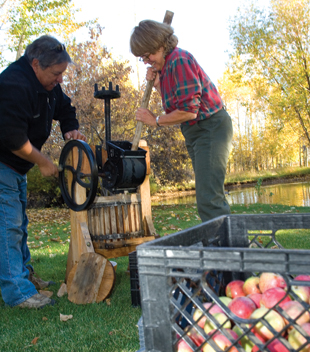
In her pilgrimage to Hailey’s orphaned trees and in the annual farmers’ market cider press she organizes, Thea makes her own contribution to the apple’s cause. As do all those folks pressing cider this time of year, or letting that cider ferment to applejack, or on to apple cider vinegar.
The forbidden fruit may have designs grander than we know. After all, the apple wormed its way into a pastry so quintessentially American that the pie stands hand in hand with Mom as a national emblem. In muffins and cobblers too, the apple redefines itself, determined to sit steaming under a frost-kissed windowpane, a piece of our own domestication.