| Current Issue : web |
| Current Issue : PDF |
| features |
| Silver Creek Seasons |
| Land of No Return |
| Sawtooth Survival |
| A Coach's Calling |
| departments |
| Joe Fos |
| Idaho's Dixie Land |
| An Herbal Life |
| A Griffon's Tale |
| Chef's Specialty |
| Valley Interview |
| calendar |
| Fall 2006 |
| listings |
| Galleries |
| Dining |
| Lodging |
| maps |
| Dining Map |
| Gallery Map |
| the guide |
| Last Summer |
| Editorial Submission |
| Calendar Submission |
| Advertising Submission |
| Advertising Rates |
| About Us |

|
|
Copyright © 2006 Express Publishing Inc. All Rights reserved. Reproduction in whole or in part in any form or medium without express written permission of Express Publishing Inc. is strictly prohibited. The Sun Valley Guide magazine is distributed free three times a year to residents and guests throughout the Sun Valley, Idaho resort area communities. Subscribers to the Idaho Mountain Express newspaper will receive the Sun Valley Guide with their subscription. |

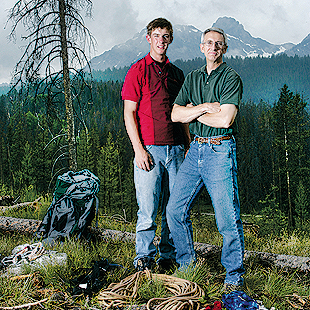
photo by David N. Seelig
Surviving the Sawtooths
Tim Dopp wanted to spend his 49th birthday climbing the Sawtooths’ highest peak. What started as a celebration nearly ended in tragedy. Words by Michael Ames. Photo by David N. Seelig.
Sometime before
dawn, after roughly 10 hours on Thompson Peak, a feeling of dread
descended on Tim Dopp. It was dark and frigid. A driving snowstorm, the
season’s first, had slammed into the Sawtooth Mountains. Enduring the cold
winds, Dopp had dozed off. He was jarred awake by the tug of a strap
connecting his belt to a crag in the cold rock behind him. He called to
his 16-year-old son, Logan, seated on a plate-sized ledge less than 10
feet above him. Logan did not answer. Tim called to him again. He called
to his son three times before Logan, now hypothermic, responded
listlessly, with a slow tongue.
As Tim clung to the side of Thompson Peak, his own life became a secondary concern. Logan would not live through the night, Tim thought, and there was nothing he could do to save his only son’s life. “I had some real feeling of dread that this wasn’t going to end well at all.”
At 6:16 p.m. on October 7, 2005, the Custer County Sheriff placed a call to the Ketchum Fire Department. Volunteer firefighter/paramedic Seth Martin manned the dispatch phones in Ketchum and was briefed on an unfolding rescue operation.
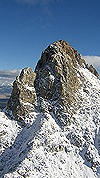
A man had called Custer County 911 with a cell phone, reporting that he and his son were trapped on 10,751-foot Thompson Peak, the highest summit in the Sawtooths, central Idaho’s jagged mountain spine. A U.S. Forest Service firefighting helicopter had flown to the peak and the crew had spotted one hiker, a dark speck stuck to the side of the towering north face, roughly 300 feet below the summit.
Lacking the necessary rescue resources, Custer County passed the call to KFD, which doubles as the command center for the Ketchum/Sun Valley Backcountry Medical Rescue Team.
 Within
minutes, Martin and KFD Captain Miles Canfield had mobilized a team of
four paramedics and one advanced emergency medical technician. The team
was en route to Sawtooth National Recreation Area headquarters, eight
miles north of Ketchum, when the helicopter crew foreman, Larry Lofswold,
radioed in, saying he could take only two rescuers and still make it back
to Thompson Peak by dark.
Within
minutes, Martin and KFD Captain Miles Canfield had mobilized a team of
four paramedics and one advanced emergency medical technician. The team
was en route to Sawtooth National Recreation Area headquarters, eight
miles north of Ketchum, when the helicopter crew foreman, Larry Lofswold,
radioed in, saying he could take only two rescuers and still make it back
to Thompson Peak by dark.
Time and weather conspired against the crew as sunset, or “pumpkin hour”—the time when all agency choppers must be grounded—approached. After his team’s initial flyby, Lofswold did not think the hikers would survive the night unaided.
Every summer since 1994, Tim and Logan Dopp have made the three-hour drive from their home in Meridian (a suburb of Boise) to Idaho’s rugged center. They backpacked and camped, and once Logan had grown strong enough, they began to summit a different peak each summer. In the past few years, the pair had successfully negotiated technical routes up Grand Mogul (9,733 feet), Mount Heyburn (10,229 feet) and Williams Peak (10,635 feet). “On the one hand, we are not complete beginners, but we are also not experts,” said Tim, who works with high school students as a seminary teacher with the Church of Jesus Christ of Latter-day Saints in Boise.
The summer of 2005 was a busy one for the Dopps, and it wasn’t until October 7, Tim’s 49th birthday, that they found a free day to tackle Thompson.
Thompson’s southern approach is an exhausting, but non-technical rock scramble. They decided it would be a hurried, but realistic day-hike, requiring no rock-climbing gear. “We have harnesses and ropes and carabineers and belay devices, but we left all that at home.”
The Dopps made quick work of the approach, but just above the Williams/Thompson saddle, upwards of 18 inches of light, early- season snow had drifted into their south-facing path. They decided to have a look at the north side, which they could access without walking through any snow. “In retrospect, at that point, we should have said, ‘It’s been a nice day for a hike, let’s go home.’ Then we broke the next rule: never climb something you can’t climb down.”
Thompson’s north face is a vertical rock carapace exposed to far more wind, but the Dopps began to scale it, thinking they could access the summit that way. Without an ounce of technical gear, they stretched for one handhold after another, securing themselves with their feet and hands, time after time, until Tim and Logan Dopp had climbed well beyond the point of sound judgment. “I had no idea how high we were … . It was only a matter of minutes when we realized we can’t go up, we can’t go down, we can’t go sideways.” Tim stood with one leg on a tissue-boxed-sized rock ledge where he could lean into the mountain. He sent Logan up one more pitch to look for an escape route. Logan climbed about 10 feet into another corner, reaching a small ledge next to an icy boulder that seemed to move when he leaned into it.
Every summer, Tim calls his wife, Barb Dopp, from the summit of a mountain he and Logan have recently conquered. Logan carried the phone, which was receiving a strong signal, and handed it to his father for a different sort of call. “I thought later, ‘What if I had dropped that phone?’” recalled Tim. “That would have been death.”
At dusk, rescuers Canfield and Martin were deposited about a quarter mile from Thompson Peak. They had visualized a route to the Dopps and were carrying packs with first-aid equipment, a global positioning system, a satellite phone, water, food, rescue harnesses, 300 feet of rope, maps, radios, helmets and headlamps.
 It was dark
within minutes and the two traversed snow-covered rock fields for more
than two hours. For the Ketchum-based rescuers, this was uncharted
territory. “Did I have experience hiking around without vision, on ice?”
said Martin. “Not really, I didn’t have much experience, no. I’ve never
had to cover an ice-covered scree field at over 10,000 feet in the dark
before.”
It was dark
within minutes and the two traversed snow-covered rock fields for more
than two hours. For the Ketchum-based rescuers, this was uncharted
territory. “Did I have experience hiking around without vision, on ice?”
said Martin. “Not really, I didn’t have much experience, no. I’ve never
had to cover an ice-covered scree field at over 10,000 feet in the dark
before.”
Risk-benefit ratios are a constant factor on any rescue situation, whether battling a fire or hiking an icy mountain. With wind whipping the snow to near zero visibility, Canfield and Martin realized they had misjudged the Dopps’ location; to reach them, they too would need to risk their lives and climb vertical rock faces without proper equipment—in the dark.
“The ratio changed,” Martin said. In a report published in Fire & Rescue Magazine, Canfield recalled the grim reality. “If we fell, we would die … We decided to retreat, knowing the victims might not survive the night.”
As night fell, the Dopps ate what little food they had. They tried to put on the extra shirts, hats and gloves they had brought along, dropping a couple of items in the process. Logan informed his dad that, against early morning advice, he had not worn any long underwear. A thin pair of Dickies was all that protected his legs.
As the cold settled on them, they spoke of past trips and future family plans. “What do you want for your birthday?” Tim asked Logan. “Heat,” was the reply.
As dawn approached, Logan had lost feeling from his thighs to his feet. Tim, standing on alternating legs, drifted in and out of sleep and dreams.
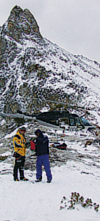
Meanwhile, a thousand feet below them, Martin and Canfield prepared their own rough accommodations. With radio guidance from a base camp, they had descended to a flat ledge where they spread rope as insulation against the rock, stuck their legs into emptied-out backpacks and shared a space blanket that eventually tore into several pieces. It was the coldest night of Martin’s life. “I think it was 10 degrees colder than the coldest night I had ever had before.”
 In the
morning, they rappelled to base camp; their considerable efforts—and
numbness—had proven futile. Through the night and early morning, rescue
coordinators ramped up their search for alternate solutions. Local expert
climbers with Sawtooth Mountain Guides were consulted, but were turned
away by the layer of verglass—a thin veneer of ice covering bare rock—that
had formed on Thompson overnight.
In the
morning, they rappelled to base camp; their considerable efforts—and
numbness—had proven futile. Through the night and early morning, rescue
coordinators ramped up their search for alternate solutions. Local expert
climbers with Sawtooth Mountain Guides were consulted, but were turned
away by the layer of verglass—a thin veneer of ice covering bare rock—that
had formed on Thompson overnight.
By Saturday at noon, 13 agencies in three states, including the U.S. Air Force, had been contacted. “Three people were on telephones nonstop for eight hours,” Martin said.
Salt Lake County Search and Rescue, Idaho Mountain Rescue, Idaho Fish and Game and the Galena Backcountry Ski Patrol sent backup for the various police, fire and medical teams from Ketchum, Sun Valley, Stanley and Blaine and Custer counties. “It was the most complicated rescue I have ever heard of,” said Mike Elle, who has worked for the Ketchum Fire Department for more than 20 years.
Meanwhile, the Dopps waited.
Logan’s condition improved as passing clouds opened brief windows of warming sunshine. Vocal communication—through simple yelling—had been established between them and base camp. “They called up and said, ‘We are not leaving without you,’” Tim remembers.
Facts on the ground were not always so positive. With unstable weather, rescuers weren’t confident a helicopter would fly by sundown. And no one, Tim Dopp included, thought they would make it through a second night. “We thought it was going to be a body recovery,” Martin said.
In the early afternoon, the National Interagency Fire Center, based in Boise, tracked down the cavalry: the Jenny Lake Rescue Team from Grand Teton National Park, Wyoming. Renny Jackson, Jenny Lake sub-district ranger, had only four men at his disposal and little time to get his team in the air over eastern Idaho. Pilot Laurence Perry flew Jackson, Brandon Torres and Chris Harder more than three hours from western Wyoming to the Thompson Peak rescue base camp, dodging several storm cells along the way and sometimes flying the helicopter just 300 feet above ground.
If there was one man in the nation fit to coordinate the Dopps’ rescue, it was Renny Jackson. With 40 year’s climbing experience and 30 years rescuing climbers in the lower 48 and Alaska (sometimes in heavy avalanche conditions on Denali at 18,000 feet), Jackson was nonetheless challenged by Thompson Peak. In terms of technical difficulty, he said, “This one was right up there.”
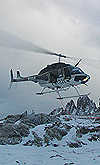
With clouds lifting, Jackson’s crew took off from base camp at 6:20 p.m. and Perry, with stunning control, hovered over the Dopps as first Jackson then Harder (on a second flight) attached themselves to the rock just below the stranded hikers. With crampons over mountaineering boots, they scaled the verglass-encased rock to the hypothermic Dopps, who were lowered by rope to an accessible point, then carried away in tandem by a long line hung from the helicopter. “The expertise of that pilot was incredible,” Tim remembers. “I was gently lifted to safety.”
By 6:50 p.m., the Dopps were at base camp and by 7:20 p.m. they were in the air on their way to Stanley.
The Dopps were flown to St. Luke’s Regional Medical Center in Boise, treated for hypothermia and released. They were home by midnight and at work and school the next day.
 Since their
fiasco, Tim and Logan have kept a cool, clear-eyed perspective on what
happened to them and why. They realize that mistakes were made. They
accept the heavy responsibility for endangering others as much as
themselves, including a yet-to-be-determined, but sizable sum owed to
Custer County. (Dopp expects it to be “in the thousands.”)
Since their
fiasco, Tim and Logan have kept a cool, clear-eyed perspective on what
happened to them and why. They realize that mistakes were made. They
accept the heavy responsibility for endangering others as much as
themselves, including a yet-to-be-determined, but sizable sum owed to
Custer County. (Dopp expects it to be “in the thousands.”)
As for that whole Man vs. Mountain thing, the Dopps are not through with this particular hunk of rock. As the summer of 2006 heated up and the seemingly bottomless snow began to peel off the walls of the Sawtooths, Tim and Logan said they would soon return to the scene of their near tragedy.
“We made some mistakes in judgment, but we are not risk takers or reckless-behavior people who have no concern for others’ welfare. So we plan to return to Thompson Peak and do it right.”