| Current Issue : web |
| Current Issue : PDF |
| features |
| Silver Creek Seasons |
| Land of No Return |
| Sawtooth Survival |
| A Coach's Calling |
| departments |
| Joe Fos |
| Idaho's Dixie Land |
| An Herbal Life |
| A Griffon's Tale |
| Chef's Specialty |
| Valley Interview |
| calendar |
| Fall 2006 |
| listings |
| Galleries |
| Dining |
| Lodging |
| maps |
| Dining Map |
| Gallery Map |
| the guide |
| Last Summer |
| Editorial Submission |
| Calendar Submission |
| Advertising Submission |
| Advertising Rates |
| About Us |

|
|
Copyright © 2006 Express Publishing Inc. All Rights reserved. Reproduction in whole or in part in any form or medium without express written permission of Express Publishing Inc. is strictly prohibited. The Sun Valley Guide magazine is distributed free three times a year to residents and guests throughout the Sun Valley, Idaho resort area communities. Subscribers to the Idaho Mountain Express newspaper will receive the Sun Valley Guide with their subscription. |

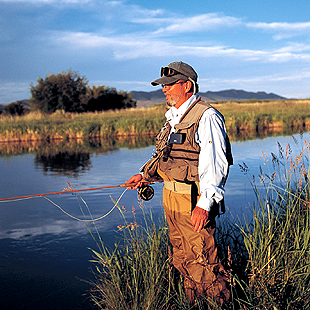
photo by Todd Kaplan
Seasons on
Silver Creek
Retired Idaho Mountain
Express
Editor and prolific fly-fishing author
Ken Retallic shares his memories of Silver Creek Preserve as it
celebrates
its 30th anniversary. Illustrations by
Lynn Toneri. Photos by Todd Kaplan.
A hundred or more
sandhill cranes swirl high overhead. My fly-fishing line floats slackly on
the wind-ruffled flows of Silver Creek as I search out their broad wings
and slender, tan-gray bodies barely visible against the pale-blue autumn
sky. The crane’s mewing calls filter down through the thin air as they
circle in a slow, spiraling ride up the brief thermals of the
late-afternoon sun for another downwind slide on their migration south.
The melodious tones of their flight chatter announce the arrival of
autumn.
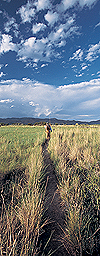
Harbingers like cranes rarely follow calendar dates for the seasons. But these ancient, stately birds are among my favorites. At Silver Creek the cranes’ early appearance in late March—you can often hear them even though you may not see them—signals the quickening promise of spring that brings the willows, dogwoods and cottonwoods alive again with feathery new leaves, sprouting buds and catkins.
The quickening may gather force too slowly for the impatient, but nature follows its course and anticipated events resolutely fall into place, regardless of anomalies in the weather. Generally, by Mother’s Day—a mere two weeks before the opening day of the fishing season—the new season of The Nature Conservancy-Idaho’s Silver Creek Preserve is nearly at its robust best. The scenery is beautiful and the wildlife is vocal.
Pale lavender blossoms of flag iris are the first blooms to appear along the narrow footpaths lining the meandering flows of the stream. And when the chokecherries blossom, it’s always a good sign that the annual migration of the warblers will soon be passing through. If there’s a good hatch of aquatic insects occurring, these colorful songbirds often pause in the trees and shrubs to refuel longer en route to their nesting grounds in northerly climes.
Several years ago, around this sublime season, a phenomenal invasion of warblers and a host of other migrants joined the creek’s earlier arrivals and resident birds. With binoculars and notebook in hand, I spotted more than 50 bird species previously unrecorded that spring in only a few hours of a drive-by visit. A fortuitous experience, to be sure. Even more fortuitously, I added two more species to my birding life list—the yellow-breasted chat and the willow flycatcher.
The chat should have been an easy find to record in my field guide—considering I’ve been visiting the creek for two decades—but the flycatcher required a long hard look in the guide book to identify it and make it a part of my official list.
Capping this remarkable day was a photograph few can ever hope for: Lined up on a low limb of a cottonwood, overhanging a gravel road, was a long-eared owl and her three fluffy chicks.
Hemingway’s legacy
This year marks the 30th anniversary of Silver Creek Preserve, situated
three miles west of the town of Picabo.
Few have known this fabled oasis in a sagebrush desert better and appreciated its bounty of flora and fauna more than Jack Hemingway, the eldest son of Ernest Hemingway, who married an Idaho native and adopted the Wood River Valley as his home.
 “There are
red-winged blackbirds calling in the cattail marshes, geese clamoring on
nesting sites ... bees are gathering pollen in the wildflowers, trout
rising to early hatches, all mixed with the sound of the stream—the
fishing regulars call it Silver Creek music,” wrote Hemingway in 1976.
“There are
red-winged blackbirds calling in the cattail marshes, geese clamoring on
nesting sites ... bees are gathering pollen in the wildflowers, trout
rising to early hatches, all mixed with the sound of the stream—the
fishing regulars call it Silver Creek music,” wrote Hemingway in 1976.
An acclaimed outdoorsman, conservationist and author, Hemingway died in 2000. Among the many accolades bestowed by family and friends at a memorial service in Sun Valley was appreciation of his role as “the savior of Silver Creek.”
“He left us an extraordinary legacy when he spearheaded the effort to preserve one of Idaho’s premier trout streams, Silver Creek,” said Idaho’s former governor, Dirk Kempthorne. “And now, the clear waters of Silver Creek beckon fly fishermen from all over the world ... a living legacy to a remarkable man.”
A legendary stream by any definition, its crystalline waters harbor a phenomenal population of trophy-sized rainbow and brown trout. The lush riparian shrubs and trees of Silver Creek Preserve provide a haven for an equally remarkable myriad of wildlife and birds (as many as 150 species of birds have been identified by explorers along the self-guided nature trail). Among its cornucopia of wildflowers is the small yellow ladyslipper orchid, a state plant species of concern.
From its genesis as the 479-acre Sun Valley Ranch—purchased in 1976 for the reduced price of $500,000 through a year-long, international fund-raising campaign launched by Hemingway—Silver Creek Preserve now encompasses 882 acres, and The Nature Conservancy has partnered with neighboring landowners to protect another 9,500 acres of Silver Creek drainage through conservation easements.
A fly fit to be
tied
The beauty of fly-fishing is that trout live in picturesque environs. Yet,
nothing captivates a fly fisher more than a progression of rise
forms—trout sipping mayflies or caddis—dimpling a stream like the
sprinkling of a gentle rain. For it’s in the “ring of the rise” that
fulfillment occurs for the fly fisher.
 Many people
think fishing is passive, but it’s not. Fly-fishing, especially, is an art
and a science as much as it’s a sport. To do it well, you have to
understand the natural histories of the fish, their habitats and their
prey.
Many people
think fishing is passive, but it’s not. Fly-fishing, especially, is an art
and a science as much as it’s a sport. To do it well, you have to
understand the natural histories of the fish, their habitats and their
prey.
So, the checklist fly fishers pay most attention to is the Silver Creek Preserve Aquatic Insect Hatch Guide. The hatch refers to the flying adult stage of aquatic insects, the most ephemeral period of mayflies and caddis that live a year or more of their short lives underwater. In turn, the chart detailing the seasonal occurrence of the bugs on the stream is a calendar dry fly fishers take to heart.
Many schedule their vacations around periods of their favorite hatches. The two most exciting favorites are the largest of the many mayfly species, the brown drake (Ephemerella) that hatches only in the first two weeks or so of June, and the tiniest of mayflies, the trico (Tricorythodes) that erupts in phenomenal numbers primarily in late-July through early August.
Equally exhilarating—when they occur in worthwhile numbers—are two other “big fish on big flies” events: the green drake (Drunella), first two weeks of July, and the gray drake (Siphlonurus), late June to early July.
Most reliable through the full season, but occurring most strongly in early spring and late autumn, is the blue-winged olive (Baetis). The other prevailing hatches, although more temperamental, are the pale morning dun and pale evening dun (Ephemerella), June through September. A season-long personal favorite is the speckled dun (Callibaetis), primarily because it’s often the trout’s first choice in a multi-hatch.
Many may think tiny Baetis are the only prime expectation in late-autumn, but a truer fall favorite is the mahogany dun (Paraleptophebia) and a generally overlooked “miniature version” of the fabled October caddis (Trichoptera). Also, truly wicked autumn weather seems to disrupt the cyclical clockworks of large-sized Callibaetis, which seem to erupt in false expectations that it’s spring again.
That’s just
the mayflies, okay?
Idaho’s river of
dreams
For those of us who call Silver Creek our “home water,” the stream is a
rare and treasured privilege that offers unique experiences on virtually
every outing. A legion of other fly fishers, who travel from around the
world to fish here, arrive with the same sense of dedication, but are
occasionally disappointed by the whims of weather or the proclivities of a
hatch. Nevertheless, they come, too, because they’re fully aware the trout
will be difficult to net.
 For there
comes a time in the life journey of a fly fisher when the soul needs
testing as much as the mind. The skills of casting, reading the water, fly
selection and presentation have been honed to fine edges. Place becomes as
important as numbers. The combination of immaculate stream with fabled
fish, awe-inspiring scenery and classic hatches commands the angler’s
quest to test his mettle.
For there
comes a time in the life journey of a fly fisher when the soul needs
testing as much as the mind. The skills of casting, reading the water, fly
selection and presentation have been honed to fine edges. Place becomes as
important as numbers. The combination of immaculate stream with fabled
fish, awe-inspiring scenery and classic hatches commands the angler’s
quest to test his mettle.
Ultimately, it brings him to Silver Creek, Idaho’s quintessential river of dreams. Silver Creek defines the essence of intellectually challenging fishing on demanding spring creeks.
Notes from
a fly fisher’s journal
Over the past decade Ken has shared his reflections on magical moments
at Silver Creek with his friend Mike, who comes down from Canada every
year to fish at the creek for a week or two. Scattered across the next
few pages are snippets from Ken’s fly fishing journals, which he has
e-mailed to Mike to help sate his fascination with the captivating
creek.
MAY: Perfect opening day
Hi, Mike … Silver Creek was incredibly magnificent with its magic
Sunday… At the same time it tested my favorite bamboo rod, thanks
to your gift, to its limits… Trout were hammering huge Callibaetis and I
had ‘the’ pattern that I’ve been telling you about in my vest…
Caught six or eight 14- to 15-inch rainbows, couple of dinks, and one
16-incher between noon and 4:30. Fortunately, action was slowing down
when I had to take son-in-law Josh back to parking lot… Went back
to island channel and decided to pound bank with over-sized Callibaetis
spinner. An 18- to 20-inch brown trout hit the fly on third or fourth
cast into cutbank in mid-channel, exploded at least 3 feet into the air,
ran short run downstream and bull-dogged into the bottom, and wouldn’t
move. Got below him, reset the reel drag, and pulled him up. He leaped
couple more times, ran right at me, I reeled too hard on the over-sized
reel—and, Bob’s your Uncle, he was gone…
JUNE: Green drakes bonanza
Hi, Mike … Cold, high winds and pelting rain roared in Saturday around
3:00 sending “los touristos” home and giving me choice of waters … .
Storm brought up a carpet of tiny Baetis, healthy numbers of sulfurs/flavs
and random appearances of struggling green drakes. Long strings of
rising pods fed on Baetis below your island in random flat stretches of
water and inside the tree-sheltered bend above the peninsula. Both
scenarios kept me chasing fish and switching flies for hours—had one
exhilarating bout with large, leaping rainbow on No. 18 blue-winged
olive thorax—but really couldn’t match hatch … finally tied on green
drake Wulff pattern around 6:00—bam! 15-inch rainbow hammered cast to
riser taking Baetis. High winds ripped water all day (Sunday) and ye ol’
bamboo got strenuous workout … started out with green drake Wulff,
whipping it against wind to visible risers: several short strikes, and
then, wham, a 16-inch rainbow hammered fly. It leaped several times, and
when I put pressure on him, it ran straight at me through weeds, broke
off leader at 5X knot and came out of weeds at my feet. Never
experienced anything like that before. Ended day with most amazing fish
of all on flat water above canoe island channel. Another pod of gulpers
had moved in and was feeding in slack water pool … . This time I was
determined to “match the hatch.” Fly that finally worked was No. 20
Baetis quill sparkle dun that I rooted out of “small Baetis” box ...
Brilliant 18-inch rainbow took it on third or fourth cast. Beautiful
fish, albeit a bit too slender after coming back from his spawning
adventures…
JULY: Sunset tableau
Hi, Mike … Glad to hear you’re out and about more often … . Have always
felt the flora and fauna experience is as meaningful as the fishing. It
was so quiet on creek Friday night that when I went back for last shot at
canoe island channel, I found a pair of sandhill cranes had settled on
second island downstream. They didn’t care about me (walking to tip of
island), and I watched fascinated as red-winged blackbirds nesting there
mobbed the cranes and snapped in a flurry of aggression at them as they
fed in soft soil. The cranes ignored the pesky blackbirds. I got closer to
these magnificent birds than I’ve ever been able to before on foot. Too
dim for a great shot with camera but recorded it anyway…
AUGUST: Island hopping brown
In late-summer, the creek occasionally enters a doldrums. Even so, one day
in late August I had to send Mike a quick note on an amazing event that
broke that day’s mold: Have had a few other minor successes at Silver on
pale evening dun hatch that never seems to last more than an hour around 6
or 7 p.m. However, the best producer has been a rusty spinner. Most
spectacular episode today was the island hopping brown (trout):
Yellow-sallies are still occasionally coming off on upper creek … . Ran
one down cutbank on inside of island point that sends water into minor
side channel just below where planks into this stretch reach water. Saw
big head come up, turn and chase fly, take it, and turn back upstream—and
next thing I saw was a 20-inch brown leap over point of island into side
channel, going away, not stopping, stripping fly in weeds—it happened
faster than you read this.
November: Autumn farewell
Hi, Mike: Silver has been stingy with hatches last couple of weekends, or
winds have blown them off before fish could get on them. Sunday, however,
produced another of its classics: intermittent flurries of Baetis,
mahoganies, Callibaetis, and the 16-18 pale evening dun that has been
skittering around late afternoon most of summer … . Bank feeder at mouth
of Loving Creek was sipping PEDs like popcorn, but only the ones that came
straight down his lane … . Froze my feet casting to him for almost 2
hours, as well as another very large feeder in shallow slack water ... .
Both take advantage of very subtle shear lines that come off bank and feed
flies into their mouths like funnels … . Almost got bank planks feeder
Saturday evening, though. He popped up and bounced a black-hair beetle off
his nose … will go looking for him again next season. Watched a large
otter cruise down through canoe island channel and around bend. Saw couple
of Virginia rails, including one that I spooked into flying, at your
downstream island where you photographed the sora. Rails are bigger and
noisier, so maybe they’re the ones you heard there this summer. Large mule
deer doe leaped almost midstream, leaped and plunged to south bank at tree
bend you worked several times above Loving Creek. She would have swamped
you if you were there. Acted like something was chasing her. A water spout
performed a whirligig like a mini tornado. Very loud and dramatic and I
sort of expected to see fish being sucked up. But it disappeared in
seconds. Eerie.
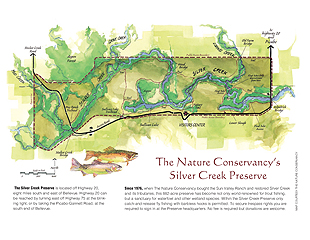
click for larger map
Silver Creek
through the years
1883: W.H. and Mary Kilpatrick homestead on Silver Creek, establishing the town of Picabo. Family history relates that “picabo” translates as “shining water” in the language of an Indian tribe that lived then in Minnesota.
1920s: Idaho Fish and Game introduces non-native rainbow trout in
Silver Creek. Native redband rainbows are eventually genetically swamped
by non-native species.
1939: Ernest Hemingway first visits Sun Valley Resort, as an
invited guest to promote hunting and fishing in the area, including Sun
Valley Ranch on Silver Creek. Over the ensuing years, he primarily hunts
in the vicinity for upland birds and waterfowl with friends including Gary
Cooper and other celebrities.
1940: The famous author’s eldest son, Jack Hemingway, fishes Silver
Creek for first time.
1955: Bud Purdy buys his grandfather’s, W.H. Kilpatrick, ranch and
establishes Picabo Livestock Company.
1961: Ernest Hemingway commits suicide in Ketchum.
1967: Jack Hemingway returns with family to live full time in
Ketchum.
1968: Idaho’s navigable stream access law tested by local fishermen
on Silver Creek to disprove landowners’ opposition to passage through
private property. Idaho Supreme Court rules that navigable waters are open
to public access to float waters or wade streambeds below high water line.
1970s: Idaho Fish and Game ends stocking of hatchery-raised rainbow
trout in Silver Creek.
1971: Jack Hemingway is appointed to Idaho Fish and Game Commission
by Gov. Cecil Andrus. He serves six years.
1975: The Nature Conservancy and Jack Hemingway launch TNC’s
largest private fund-raising drive in the West to purchase the 479-acre
Sun Valley Ranch for the reduced price of $500,000.
1976: Acquisition of the ranch is announced and Silver Creek
Preserve established. Guy Bonnivier is hired as the first employee to
oversee fencing and construction of visitor center cabin. Hard work begins
to restore deteriorating habitat.
1977: The Nature Conservancy initiates fly fishing-only,
catch-and-release fishing regulations on the preserve.
1978: Brown trout, a European species, is introduced into Silver
Creek. Transplants end two years later.
1979: Regulated three-day-per-week waterfowl hunt on Silver Creek
Preserve is negotiated. Idaho Fish and Game spreads the word that fishery
is rebounding.
1980s: TNC-Idaho begins a campaign to acquire conservation
easements to forestall development along Silver Creek and its tributaries.
Idaho Fish and Game establishes Silver Creek West-Point of Rocks public
fishing access site downstream from Silver Creek Preserve. Picabo
Livestock Company opens its lands in same area to public fishing.
1986: Guy Bonnivier is named executive director of TNC-Idaho. Jack
Hemingway’s book Misadventures of a Flyfisherman is published.
1989: Idaho Fish and Game reports angler use and success rates have
doubled since 1977 at Silver Creek Preserve.
1991: Jack Hemingway helps launch and hosts Incredible Idaho, a
wildlife television show by Idaho Fish and Game in cooperation with KTVB
in Boise.
1996: Bud Purdy and his son, Nick, donate conservation easement of
3,400 acres along Silver Creek to TNC-Idaho—a $4 million gift.
1997: Addition of May Ranch properties to Silver Creek Preserve
adds 284 acres and one mile of Stalker Creek to preserve.
1999: Guy Bonnivier resigns as executive director of TNC-Idaho.
2000: Jack Hemingway dies on December 2. Eulogized as the “savior
of Silver Creek.” Winter fishing season on lower Silver Creek is
authorized.
2001: Idaho Fish and Game dedicates Silver Creek West access site
in memory of Jack Hemingway. October 10 is declared Jack Hemingway
Conservation Day.
2006: Silver Creek Preserve encompasses 882 acres, and TNC-Idaho
partners with neighboring landowners to protect another 9,500 acres of
Silver Creek drainage through conservation easements.