| Current Issue : web |
| Current Issue : PDF |
| features |
| Silver Creek Seasons |
| Land of No Return |
| Sawtooth Survival |
| A Coach's Calling |
| departments |
| Joe Fos |
| Idaho's Dixie Land |
| An Herbal Life |
| A Griffon's Tale |
| Chef's Specialty |
| Valley Interview |
| calendar |
| Fall 2006 |
| listings |
| Galleries |
| Dining |
| Lodging |
| maps |
| Dining Map |
| Gallery Map |
| the guide |
| Last Summer |
| Editorial Submission |
| Calendar Submission |
| Advertising Submission |
| Advertising Rates |
| About Us |

|
|
Copyright © 2006 Express Publishing Inc. All Rights reserved. Reproduction in whole or in part in any form or medium without express written permission of Express Publishing Inc. is strictly prohibited. The Sun Valley Guide magazine is distributed free three times a year to residents and guests throughout the Sun Valley, Idaho resort area communities. Subscribers to the Idaho Mountain Express newspaper will receive the Sun Valley Guide with their subscription. |

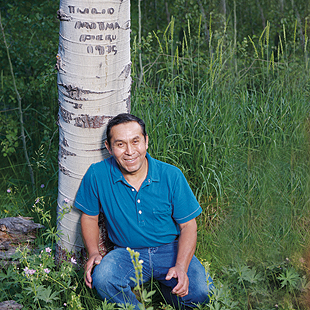
photo by David N. Seelig
Carving his name
in aspen
Betty
Bell discovers a face behind the
forest’s graffiti. Photo by David N. Seelig.
In the summer of
1977, I was running the front loop trail in Adams Gulch north of Ketchum,
when I spotted my first Julio Mitma, a carving that eventually turned into
the discovery of a veritable aspen tree gallery of carvings, though their
maker was a phantom carver to me for decades.
The sun highlighted the carving that morning, and, though it was against my religion to stop on a run save for serious injury to weight-bearing bones, I sinned. I stopped. I read: Julio Mitma, 1977, Peru.
This was no callow youth’s carving—the usual heart with his and his truelove’s initials ineptly gouged, hurtfully deep. This was the work of an artiste, and I lingered to trace J-u-l-i-o M-i-t-m-a with my finger, even though my venial sin morphed to mortal while I lingered.
After that discovery I was always on the lookout for Mitma carvings, and before the snows fell I’d found 14 in Adams Gulch, Lake Creek and Eagle Creek as well.
It was likely serendipity two summers ago that led to my discovery of a Julio Mitma working in the maintenance department at Hailey Elementary School. Surely there aren’t two Julio Mitmas, I thought. I was right.
I sought out Mr. Mitma and met with him in the school lunchroom. His face is shaped like the Marlboro man’s, that broad shape that age treats kindly, but Julio’s is gentled, serene. He’s 59, he said, and I had a hard time not asking a frivolous question: How come your hair’s still all the way black?
Julio had been in the vanguard of Peruvian sheepherders who, about the time he arrived, were gradually replacing the Basques. “They’re all Peruvian now,” he said.
Julio arrived in the United States in 1973, his green card updated in 1985 to permanent resident status. His first assignment was in Adams Gulch. I asked him if he knew English then. He shook his head no and said, “The hippies helped me.”
Hippies, he explained, when he saw my eyebrows go up, were the itinerant campers in every canyon, campers who had to change their campsites, just a bit, to stay legal. Some became regulars at Julio’s wagon, sharing his coffee, each picking up from the other words to get by with.
“And I had my dictionary, too,” Julio said, and he went to his locker and fetched a paperback edition of the 1968 New American Dictionary. He said it had been a gift, and he held the well-thumbed book the way you hold something you prize.
Julio used a small pocketknife to carve, and when I asked him what made him start carving, he said, “Well, the Basque guys had their names all over the place—I couldn’t let it stay like that. Those guys carved so many trees I had to sit on my horse to get above them.”
Asked if he had a favorite carving, he nodded yes, and he looked a bit nostalgic, I thought. “It’s on a giant spruce tree back in Eagle Creek,” he said. “Way up high—way out on the highest point, as far out as you could get.” He added that there wasn’t another carving anywhere up there, so he didn’t have to sit on his horse to do it.