| Current Issue |
| features |
| Hemingway's autumns |
| The Aspen Tree |
| Rocky Mountain Elk |
| Kevin Syms |
| Rember's 'Traplines' |
| Views and Windows |
| Mountain Weather |
| Idaho Trout |
| calendar |
| Fall 2005 |
| listings |
| Galleries |
| Dining |
| Lodging |
| maps |
| Gallery Map |
| the guide |
| Last Summer |
| Advertising |
| About Us |
|
Copyright
© 2005 Express Publishing Inc. All Rights reserved. Reproduction in whole or in part in any form or medium without express written permission of Express Publishing Inc. is strictly prohibited. The Sun Valley Guide magazine is distributed free twice yearly to residents and guests throughout the Sun Valley, Idaho resort area communities. Subscribers to the Idaho Mountain Express newspaper will receive the Sun Valley Guide with their subscription. |

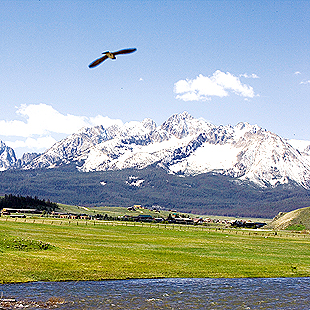
Photo by David N. Seelig
A melancholy memory
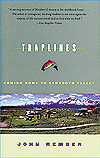
John Rember's 'Traplines'
evokes
the true nature of his own public Idaho
By Jennifer
Pattison
The pioneering spirit of Idaho flows in the blood of author John Rember, instilled there by a childhood in the heart of Sawtooth Valley. In the book “Traplines: Coming Home to Sawtooth Valley,” he captures that spirit in a stark and unrelenting way.
The words between the covers of this autobiographical work exact a truth hidden beneath the well-intentioned struggle against change. From naive enthusiasm at the introduction to the valley of power lines and summer cabins in the ’50s, to condescension at the government’s efforts to halt such visible signs of human progress in 1972, with the creation of the Sawtooth National Recreation Area, Rember presents the perspective of the land from one who is irrevocably a part of it.
Rember extracts a lesson from the history of Sawtooth Valley. Once something has been altered by humanity, attempting to recapture its former state results in a museum-like, hypocritical existence, where farmed fish swim in place of their wild cousins and a population of caretakers flows between the mountain peaks in place of cattle. But, as Rember reflects, “There are worse lives than those lived in museums.”
In the following excerpts from “Traplines” Rember evokes the struggle of man, beast and mountain against the tide of civilization.
 “In 1987 I cashed out
of the ski resort of Sun Valley, Idaho, and went fifty miles north to my
family’s place in Sawtooth Valley to build a house. I did so out of a
deep homing instinct—the same forty acres that had sustained our tiny
herd of horses every summer for thirty-five years had sustained, for me,
a vision of a place where I belonged in the world, where I could get up
in the morning, step out the door, and catch dinner from the Salmon
River, or simply step out to watch the sunrise light the Sawtooths above
their dark foothills.”
“In 1987 I cashed out
of the ski resort of Sun Valley, Idaho, and went fifty miles north to my
family’s place in Sawtooth Valley to build a house. I did so out of a
deep homing instinct—the same forty acres that had sustained our tiny
herd of horses every summer for thirty-five years had sustained, for me,
a vision of a place where I belonged in the world, where I could get up
in the morning, step out the door, and catch dinner from the Salmon
River, or simply step out to watch the sunrise light the Sawtooths above
their dark foothills.”
•
“It was a kind of paradise we lived in. We had electricity, paved roads, a new ’56 Ford, and an endless string of professional visitors … who assured us that we were living the kind of life they would live if they could only break free of their responsibilities to live it.”
•
 “There are still cows
in the valley, but their owners worry more about the price of money than
the price of beef. The ranches are still here, as pastoral as ever, but
their owners are often elsewhere, especially during the coldest part of
the winter. Some of the old ranch houses have been torn down and giant
new log homes have been built for new owners, who live here during the
summer and fall.
“There are still cows
in the valley, but their owners worry more about the price of money than
the price of beef. The ranches are still here, as pastoral as ever, but
their owners are often elsewhere, especially during the coldest part of
the winter. Some of the old ranch houses have been torn down and giant
new log homes have been built for new owners, who live here during the
summer and fall.
We have a population of caretakers.”
•
“Everyone is living out his or her own story on the trail. Stories are artifice, and when you live your own story what you’re doing is placing one artifact—the self—within another artifact—the story. You’re making a thing like an Oriental carving, a thing like a jade bird with delicate jade feathers enclosed in a cage of woven jade reeds. It’s fragile. The whole thing can shatter if you drop it.
 Get out in the wild,
away from houses, cars, diplomas, software, and jobs. Then stop
speaking, lose language, fail to grasp the word, and your self just
might begin to slip from your story. We all instinctively know that.
It’s why people on the Iron Creek Trail tell people they’ve just met
intimate details of their own lives. It’s why they carve their name on
trees on the shores of Sawtooth Lake. It’s why they shoot guns and
spray-paint rocks and toss beer cans into twenty feet of crystal-clear
water. They’re making their stories strong enough.”
Get out in the wild,
away from houses, cars, diplomas, software, and jobs. Then stop
speaking, lose language, fail to grasp the word, and your self just
might begin to slip from your story. We all instinctively know that.
It’s why people on the Iron Creek Trail tell people they’ve just met
intimate details of their own lives. It’s why they carve their name on
trees on the shores of Sawtooth Lake. It’s why they shoot guns and
spray-paint rocks and toss beer cans into twenty feet of crystal-clear
water. They’re making their stories strong enough.”
•
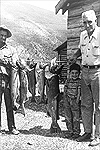
“Lately I’ve been thinking about all the sadness that attends the death of a salmon run. I remember seeing schools of sockeye swim in Redfish waters, and I remember the spawning Chinook that were thick in the river where it runs through the pasture west of my house.”
•
“One of the things that happens when we get confronted with no-fish-where-fish-used-to-be is that we remember moments when we looked with wonder at a world not entirely reduced to human dimension.
 The grief that
attends that memory is unbearable. That’s why we pretend that the runs
can be restored again, as if those restored runs would be anything but
the Chinook and sockeye equivalent of planted rainbow. If we admit what
has finally happened—that the wild runs are extinct—we end up … mourning
the death of the poor fish, but actually mourning the death of a
wondering part of ourselves.”
The grief that
attends that memory is unbearable. That’s why we pretend that the runs
can be restored again, as if those restored runs would be anything but
the Chinook and sockeye equivalent of planted rainbow. If we admit what
has finally happened—that the wild runs are extinct—we end up … mourning
the death of the poor fish, but actually mourning the death of a
wondering part of ourselves.”