| Current Issue |
| features |
| Hemingway's autumns |
| The Aspen Tree |
| Rocky Mountain Elk |
| Kevin Syms |
| Rember's 'Traplines' |
| Views and Windows |
| Mountain Weather |
| Idaho Trout |
| calendar |
| Fall 2005 |
| listings |
| Galleries |
| Dining |
| Lodging |
| maps |
| Gallery Map |
| the guide |
| Last Summer |
| Advertising |
| About Us |
|
Copyright
© 2005 Express Publishing Inc. All Rights reserved. Reproduction in whole or in part in any form or medium without express written permission of Express Publishing Inc. is strictly prohibited. The Sun Valley Guide magazine is distributed free twice yearly to residents and guests throughout the Sun Valley, Idaho resort area communities. Subscribers to the Idaho Mountain Express newspaper will receive the Sun Valley Guide with their subscription. |

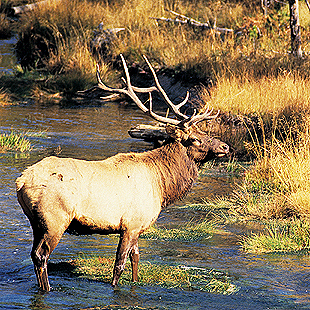
Photo by Ken Retallic
The
fall and rise
of a species
Rocky Mountain
Elk thrive
in the Wood River Valley
By Greg Stahl
When the mountains of Central Idaho echo in early morning with the haunting bugles of an elk, the tawny fingers of autumn have surely begun to tighten their grip.
“It’s a pretty amazing sound when you’re up in the mountains. It really echoes down through a canyon,” said Kelton Hatch, a lifelong Idahoan, hunter and conservation educator for the Idaho Department of Fish and Game’s Magic Valley Region. “It’s one of those sounds of the wild that’s really hard to give just an explanation to unless you’ve actually heard it.”
The magic of a bull elk’s mysterious autumn mating call is more common now than at any time since Europeans settled this part of the West. The Wood River elk herd is probably as healthy as it has ever been, and the number of bulls as a percentage of overall herds is among the healthiest bull-to-cow ratios in the West.
But the herd’s current vigor is not indicative of past trials. Nor does it indicate the increasing struggles the signature Rocky Mountain species faces each year, as this rural part of Central Idaho grows increasingly urban.
By the close of the 19th century, elk were nearly eliminated from the Wood River Valley and from many other parts of Idaho. They grew scarce as trappers, miners and ranchers settled the area in the late 1800s and shot them without regard for the overall population.
“The elk were basically extirpated in the early 1900s,” said Fish and Game Regional Wildlife Biologist Randy Smith. “But we brought elk in from Yellowstone National Park in the 1930s.”
As hunting regulations were established, herds began to recover, and, by 1947, populations grew healthy enough to issue hunting permits. Elk have been hunted in this area every year since 1950, and, today, populations have reached an all-time high. They thrive with the vigor of several easy winters, decades of winter feeding and improved summer habitat conditions.
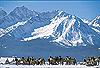
In a typical Central Idaho winter, snows cover the area in a heavy icing from November through March. As the flakes pile up, elk are forced to leave their summer ranges high in nearby mountains, and descend in search of food. As they travel, they follow long-established migration routes toward winter ranges where they have a better chance of surviving cold temperatures, biting winds and drifting snow.
Winter ranges include south-facing slopes and low-elevation meadows where shallower snow depths and protection from harsh winds are available.
For elk, this is where the rub is.
The same reasons elk move to winter range (sunny, sheltered exposures) are reasons people prize those areas for their homes. Throughout the rapidly growing Wood River Valley, elk winter range has been, and continues to be, gobbled up at a rapid pace by homes, condominiums and townhouses.
•
“All of your elk wintering habitat is being eaten up by those subdivisions,” Hatch said. “If we don’t get something set up, some easements or some other mechanism, elk are going to be a thing of the past.”
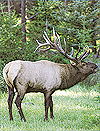
The Rocky Mountain elk is a beautiful and very popular animal. The large ungulates are strong and flourish in many habitats. The stereotypical image of a massive bull elk with large antlers is synonymous with the Rocky Mountains.
Elk are direct descendants of red deer, which entered North America long before humans, perhaps as early as 120,000 years ago, according to the Rocky Mountain Elk Foundation. The theory is that they crossed the same land bridge from Asia that Native Americans later crossed. Biologists consider North American elk to be the same species as red deer in Asia today.
 Elk probably thrived
throughout North America until Europeans began settling the continent.
Settlers hunted elk for meat and sport, and to protect property and
crops. But people affected elk most drastically by converting their
habitat and migration corridors into farms, homes and cities.
Elk probably thrived
throughout North America until Europeans began settling the continent.
Settlers hunted elk for meat and sport, and to protect property and
crops. But people affected elk most drastically by converting their
habitat and migration corridors into farms, homes and cities.
Elk and other members of the deer family belong to a group of animals called ungulates, the Latin word for hoof. This large group, composed wholly of animals with hooves, refers to two distinct orders: Artiodactyla and Perissodactyla. The number of toes is the easiest way to divide ungulates into these two groups.
Artiodactyls include elk, deer, bison and pronghorn. They have even numbers of toes. Perissodactyls include horses and elephants, and they have odd numbers of toes.
Elk are herbivores, and their diet includes 10 to 15 pounds of grasses, flowering plants, shrubs and trees each day. Elk gather in herds, in part, because this enables them to eat and watch for predators simultaneously. In a group, at least one animal is standing guard while the others eat.
In North America, there are several elk subspecies, including Rocky Mountain elk, Tule elk, Roosevelt elk, Manitoban elk, as well as two extinct subspecies: eastern and Merriam elk.
Antlers, which sprout at a rate of up to 1 inch a day, grow faster than any other kind of bone. Each spring, male elk begin growing antlers from pedicles, which are bony bumps on their skulls. Increasing daylight elevates the level of testosterone in their blood, which triggers antler growth.
Antlers begin as layers of cartilage, which mineralize into bone. A soft covering of velvet helps protect the antlers and carries blood to the growing bone tissue.
Elk antlers contain grooves and ridges, which mark the paths of veins that carried blood throughout the growing season.
The blood stops flowing to the antlers in August and they finish hardening. The velvet falls off or is rubbed off. Hardened antlers are composed of calcium and phosphorous, and as much as 50 percent water.
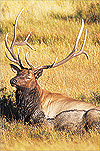
In his second year, a bull elk usually grows branchless antlers called spikes. By the third year, antlers begin developing tines that branch away from the main structure. By a seventh summer, antlers have six tines each and weigh up to 40 pounds.
Antlers are signs of mature, well-fed bulls, and cows are more likely to mate with well-racked males.
People who enjoy elk—hunters and non-hunters alike—bring in millions of dollars to local economies. Their money bolsters the economies of small towns where they buy fuel, rent rooms and hire outfitters. In fact, Hatch said hunters spent 104,192 hours hunting in Idaho last year, and each year hunters and anglers contribute $3.2 billion to Idaho’s economy.
Because elk winter range is limited, a number of local residents advocate for supplemental feeding during the snowy months of the year. Fish and Game frowns on the practice of private feeding, but it, too, maintains feed sites at locations throughout the state.
Feeding advocates argue that too much winter range has been gobbled up by urban sprawl. The elk have nowhere to feed, so people, who have overrun the range, must provide.
Fish and Game argues that feed sites are cesspools for disease and also train elk to ignore their natural instincts.
“We’ve got some of the healthiest elk populations in the Wood River Valley that we’ve ever had,” Smith said. “I’m not convinced we wouldn’t have very healthy populations without the feeding there. There are a lot of people who are seeing that it’s not necessarily a good thing to concentrate these elk and feed them in an artificial manner.”
Monte Straley isn’t one of them.
According to Straley, the winter of 2001-2002 was particularly hard on local elk populations.
“Every elk that was not fed was dead in the spring,” said Straley, co-organizer of the Wood River Elk Trust.
Straley and a handful of other local volunteers have been raising money to feed local elk populations for more than 12 years.
Gary Shelton, the other co-organizer for the Wood River Elk Trust, agreed that local elk need help to successfully make it through the winter.
 “We are in the middle
of another harsh winter, with snow packs above average for this date,”
he wrote in a 2004 letter seeking donations to pay for feed, as well as
habitat restoration projects. “As a last resort, local groups are
feeding elk in areas where their historical winter range has been
reduced to houses and their down-valley migration routes blocked by
human development.”
“We are in the middle
of another harsh winter, with snow packs above average for this date,”
he wrote in a 2004 letter seeking donations to pay for feed, as well as
habitat restoration projects. “As a last resort, local groups are
feeding elk in areas where their historical winter range has been
reduced to houses and their down-valley migration routes blocked by
human development.”
Despite the last few years of easy winters, elk still died.
Last winter, one of the easiest winters on record, helped drive the point home when the new owners of the Warm Springs Ranch property decided to call an end to a decades-old elk feeding operation. The ranch is a 77-acre area in northwest Ketchum, where a golf course will soon be closed and transformed into a resort development. When the feeding ended, chaos ensued.
•
Some elk moved onto south-facing slopes, but others moved east into Ketchum, where people set up several rogue feeding sites. In some cases, elk devoured extensive amounts of ornamental vegetation.
According to Shelton, the elk trust has helped to feed 100 or more elk at the Warm Springs property, where tourists have long been able to ride horse-drawn sleighs to view the animals at the feed site. Additional small groups of elk are fed in scattered locations throughout the Wood River Valley, including an annual feed site on south-facing slopes in Elkhorn and in Bellevue.
Straley acknowledged that Fish and Game already has feeding operations, but he said the agency’s efforts are usually too little too late.
“Their idea of feeding time—it’s way too late,” he said. “If you’ve got that much snow and that much cold, you’ve already lost.”
Hailey-based Fish and Game Conservation Officer Roger Olson said the department’s goal in feeding at a location about 10 miles up the Warm Springs drainage is not necessarily to help the animals make it through a harsh winter.
“The reason we feed is not because elk are deteriorating in body condition, but to hold them up higher in the drainage and not have them run down to Ketchum,” he said.
This is a point on which local elk feeding advocates and state officials strongly disagree.
According to Fish and Game Wildlife Biologist Bret Stansberry, the department seeks to maintain big game populations under natural conditions, allowing the animals to feed on naturally available forage.
“The department feels that big game numbers should be in harmony with the amount of winter forage available,” he said. “Fish and Game does not condone providing supplemental feed in order to sustain herds of big game above what the winter range can normally support.”
But most of the winter range is buried beneath subdivisions, and Shelton and Straley said the entire herd could easily be wiped out during a hard winter if feeding does not occur.
“Some years, you could lose every elk up here if you didn’t feed them,” Straley said. “We’ve taken all the winter range, or most of it.”
Even during easy winters, feeding elk helps prevent the animals from moving into subdivisions and eating ornamental vegetation, and from crossing roads and highways unnecessarily, Straley said.
•
Olson, however, said there is winter range in the Wood River Valley that elk do not use when they are fed. Also, he said feed sites create an unhealthy environment in which animals can easily transmit diseases and cause environmental damage. Feed sites are also locations where predators may be attracted to pick off easy meals.
“If you look at both deer and elk in a wild situation, you don’t see 100 elk standing together,” Olson said. “They break up into small units of three, four, five or a dozen. If they don’t stay concentrated, they can make it on their own.
“By feeding them, we are also discouraging them from doing what they are designed to do.”
 Further, Olson said
it is perfectly natural for wild animals to die during the winter.
Further, Olson said
it is perfectly natural for wild animals to die during the winter.
“It’s part of the selection process,” he said. “It’s only when high numbers of wildlife die, and that’s when we approve of supplemental feeding.”
Straley maintains that the local feeding efforts are simply designed to help the animals cope with the unnatural impacts human development of the valley has caused.
“Elk can be fed very successfully,” he said. “It may not be the best thing to do, but it’s the only option you have some years.”
Reiterating what both groups already know, Stansberry pointed out that the issue of feeding is very contentious.
“Winter feeding of wildlife is a very controversial issue wherever it occurs, generating very passionate feelings on both sides of the issue,” he said. “The main thing is to give serious thought to the pros and cons of feeding before jumping on the feeding bandwagon. A thoughtful approach to this dilemma will be much better for the animals you are trying to help.” •