| Current Issue |
| features |
| Hemingway's autumns |
| The Aspen Tree |
| Rocky Mountain Elk |
| Kevin Syms |
| Rember's 'Traplines' |
| Views and Windows |
| Mountain Weather |
| Idaho Trout |
| calendar |
| Fall 2005 |
| listings |
| Galleries |
| Dining |
| Lodging |
| maps |
| Gallery Map |
| the guide |
| Last Summer |
| Advertising |
| About Us |
|
Copyright
© 2005 Express Publishing Inc. All Rights reserved. Reproduction in whole or in part in any form or medium without express written permission of Express Publishing Inc. is strictly prohibited. The Sun Valley Guide magazine is distributed free twice yearly to residents and guests throughout the Sun Valley, Idaho resort area communities. Subscribers to the Idaho Mountain Express newspaper will receive the Sun Valley Guide with their subscription. |

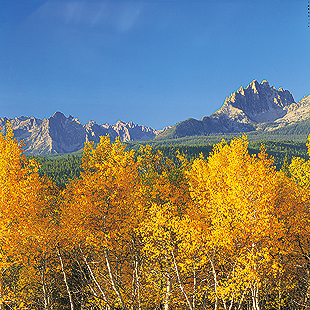
Photo by Steve Platzer
The aspen tree
The story behind the
fall forests’ golden flare
by Mia James
Any image of autumn in the Wood River Valley is almost certain to focus on the telltale yellow and golden leaves of aspen stands. Though appreciated for its summer shade and silent stillness in winter, the aspen is renowned for its spectacular displays each fall.
As you admire this season’s arboreal display, bear in mind that these aspen stands are far more than flash and flare; they are a vital, complex member of our ecosystem whose contribution to local wildlife and environmental stability is invaluable.
 The aspen species
native to this region is Populus tremuloides, or quaking aspen—so named
because of the characteristic tremble of the tree’s leaves with the
slightest breeze. This “quaking” is produced by a flat leaf stem. Other
distinguishing traits include egg-shaped leaves with a shiny green
surface and a duller hue beneath, and cream-colored bark that darkens
with age.
The aspen species
native to this region is Populus tremuloides, or quaking aspen—so named
because of the characteristic tremble of the tree’s leaves with the
slightest breeze. This “quaking” is produced by a flat leaf stem. Other
distinguishing traits include egg-shaped leaves with a shiny green
surface and a duller hue beneath, and cream-colored bark that darkens
with age.
In the wild, aspen grow in stands, living off a single root system. This root system supports regeneration as aspen propagate by cloning. New growths, called suckers, are sent up following any large-scale disturbance that destroys older trees. The sucker is referred to as a “pioneer” tree, meaning that aspens are likely the first species to grow in a zone following a disturbance. Fire is the most common and effective event in the regeneration cycle, but avalanches and clear-cutting also promote aspen revegetation.
•
As each tree ages, it becomes more vulnerable to disease, making the aspen stand dependent on periodic disturbances and the ensuing new growth for survival.
 Other factors in
aspen sustainability are full-sun exposure and ample water. Though they
can survive with only moderate amounts of moisture—as we see
locally—aspens develop best in wetter conditions.
Other factors in
aspen sustainability are full-sun exposure and ample water. Though they
can survive with only moderate amounts of moisture—as we see
locally—aspens develop best in wetter conditions.
Beyond its obvious beauty, the quaking aspen’s hardiness in this region’s harsh climate makes it a popular choice for landscape use. The species is a proven survivor in spite of our altitude and severe weather conditions. It thrives with regular irrigation. The excellent bird habitat furnished by an aspen stand is yet another reason homeowners often choose the aspen—that and its fall beauty.
While the aspen is undoubtedly tough, there are a few key considerations to ensure its health when transplanted. Bill Josey of Hailey-based Arborcare Resources Inc., a tree care service, recommends starting with smaller trees—such as a one-gallon container. The smaller aspens will be healthier in the long run and thus quickly gain the same size as larger transplants.
“Aspens want to revert to genetics and become a stand,” Josey further explains.
 Due to this tendency,
quaking aspen planted as single-specimen trees tend to struggle, and are
more susceptible to disease. Due to a lack of reserve energy, aspens do
best in a multi-age stand (as they occur in nature), where mature trees
are replaced by younger growth as they weaken. Aspens are short-lived
and thus dependent on this process in which the loss of a single tree
prompts the regeneration of new suckers.
Due to this tendency,
quaking aspen planted as single-specimen trees tend to struggle, and are
more susceptible to disease. Due to a lack of reserve energy, aspens do
best in a multi-age stand (as they occur in nature), where mature trees
are replaced by younger growth as they weaken. Aspens are short-lived
and thus dependent on this process in which the loss of a single tree
prompts the regeneration of new suckers.
Domestic aspen stands should not be managed as individual trees, but rather as a stand. Larger, less healthy trees should be cut down—a practice that has the added advantage of managing height while promoting thickness.
•
Human management of aspen stands is not limited to domestic landscapes. While the aspen tree is still widespread in this region, it does face its share of challenges. As wild lands are increasingly controlled, the natural disturbances on which aspens depend for regeneration have been reduced or eliminated from the cycle.
Fire is a primary example. As wildfires are increasingly controlled and extinguished, aspens are denied the most significant influence in their regeneration. Without regular removal of older trees, stands fail to send up new suckers. Instead, conifers benefit from the rich soil created by aspens and overtake the original stand.
•
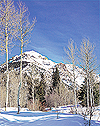 In a process U.S.
Forest Service biologist Bobbie Filbert refers to as “conifer
encroachment,” conifers exceed the aspen’s height and block much needed
sun from reaching the struggling young aspens. Eventually the conifers
take over, reducing the aspen population until it is eliminated.
In a process U.S.
Forest Service biologist Bobbie Filbert refers to as “conifer
encroachment,” conifers exceed the aspen’s height and block much needed
sun from reaching the struggling young aspens. Eventually the conifers
take over, reducing the aspen population until it is eliminated.
Wildlife management has also had a formidable impact on quaking aspen populations.
As predators such as wolves and grizzly bears have been reduced or removed from many areas, ungulate populations including deer, elk and moose have flourished. Aspens have suffered as these large herds graze on and destroy young sprouts (suckers). Stands again lose their potential to regenerate.
Filbert explains that measures are being taken to restore aspen health and ensure its survival. She cites prescribed fires as an effective way to restore necessary disturbance to the system—a procedure that at once removes encroaching conifers and encourages new aspens to sprout. Fire also restores the pH balance of the soil while adding organic carbon. In turn, these added nutrients further promote aspen health and regeneration. Though probably not as effective, alternatives to prescribed burns also exist. For example, mature trees can be cut down to allow new growth.
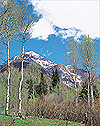 Concern for the
quaking aspen’s future is well justified. Apart from the tree’s
much-loved visual contribution, they serve a range of ecological needs.
Concern for the
quaking aspen’s future is well justified. Apart from the tree’s
much-loved visual contribution, they serve a range of ecological needs.
“There is amazing biodiversity in an aspen stand,” Filbert explains. The loss or significant reduction of aspen trees takes away an important wildlife habitat that provides shelter and nourishment for many bird species and small and large mammals alike.
The aspen’s contribution to the ecosystem continues. It protects watersheds by accumulating more snow than conifers and producing an earlier spring snowmelt. As a pioneer species, aspens stabilize soil after a disturbance and enrich it with nutrients such as phosphorus, potash and calcium. This process enhances the health of many other plant species and the greater ecosystem.
The beauty of it all can be seen each fall.
5 great spots
to see fall color
· Adams Gulch is just north of Ketchum’s downtown and loaded with
aspen-lined trails. Stroll out the jeep road or head higher into the
hills on several routes.
· Proctor Mountain Trail’s dense aspen always deliver some of the
valley’s richest color. The new trailhead is appropriately located east
of the Sun Valley Lodge at the fabled Hemingway Memorial overlooking
Trail Creek, where a plaque reads “Best of all he loved the fall…”
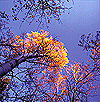 · Drive north over Galena Summit to the Sawtooth Valley and cruise on
to either Pole Creek Road or Fourth of July Road. Each is loaded
with aspens and the roads’ rougher surfaces will force you to slow down
and not miss a thing. You’ll also find plenty of opportunity to get out
and take a walk.
· Drive north over Galena Summit to the Sawtooth Valley and cruise on
to either Pole Creek Road or Fourth of July Road. Each is loaded
with aspens and the roads’ rougher surfaces will force you to slow down
and not miss a thing. You’ll also find plenty of opportunity to get out
and take a walk.
· Head up to Pioneer Cabin before too much snowfall covers the
trail. You’ll be rewarded with both fall color and one of the most
spectacular views of the snow-capped Pioneer Mountains.