arts
The Idaho Bookshelf
Van Gordon Sauter’s second foray into the rich bibliography of works by Idaho authors and those deeply informed by the Idaho experience.
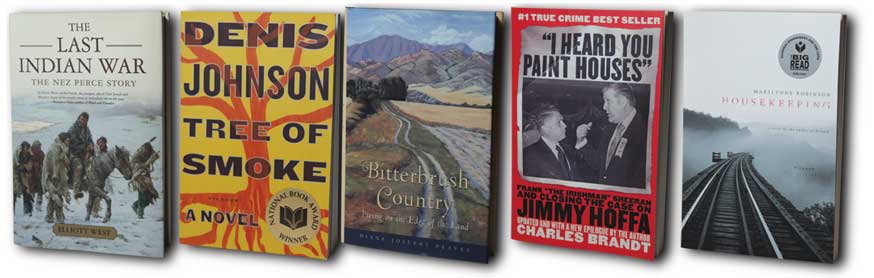
Tree of Smoke: A Novel
By Denis Johnson,
Picador, 2008
Denis Johnson, whose past life sounds like an exhaustive catalogue of the horrors of addiction, is now an esteemed novelist and journalist, though seemingly falling into that quietly concerning category of the “reclusive writer living in Northern Idaho.”
A few years ago he published Tree of Smoke, arguably the best novel about Vietnam. Long, intense, at times almost hallucinogenic, like the war itself, it is an excruciatingly realistic portrayal of the ultimate “Vampire Mausoleum” and the array of characters that made it a scene of unpre-cedented knavery and heroism.
If you fell under the rich psychotropic spell of Francis Ford Coppola’s Apocalypse Now Redux, this is the war novel for you. And if you like to engage a writer with a mastery of character and depiction, this is the novel for you.
Johnson’s National Book Award-winning work captures the unreality that is the reality of war.
Bitterbrush Country: Living On the Edge of the Land
By Diane Josephy Peavey,
Fulcrum Publishing, 2001
“My home is the vast, open landscape of south-central Idaho, at once a sanctuary, a source of strength, and a heartache.”
So begins this collection of essays for Idaho Public Radio about life in rural, indeed, remote Idaho. Peavey’s essays actually range beyond the ranch, but always focus on the rural life. She married third-generation rancher John Peavey in 1980 and their main home is the Flat Top Sheep Ranch, at the end of a 24-mile dirt road north of Carey.
The Peaveys are ranchers and environmentalists. Both are committed to their land, their animals and their communities. Her stories are addictive. They capture the core reality of rural Idaho—the Idaho that existed when Ketchum was the major sheep-shipping center in our country, and second only to Sydney, Australia in the world.
The essays cover an incredible range of topics, and anyone with a passion for working dogs will never forget her loss of a border collie to a rattler. It is emblematic of a life close to the ground in a land that is both generous and inherently severe.
The Last Indian War: The Nez Perce Story.
By Elliott West,
Oxford University Press, 2009
The book jacket illustration is wrenching, emblematic of this remarkable—and remarkably told—story.
It depicts several Indians, only one of them mounted, struggling through deep snow, depleted emotionally and physically by the hardship, having been on the run for months from an inept but relentless American Army.
In 1877 (one year after the Custer fiasco), 750 Nez Perce men, women and children fled their tribal home in Oregon, crossed Idaho and made their way through Montana in what ended as a desperate effort to evade American troops and find sanctuary in Canada.
While the tribe prevailed in some pitched battles, it ultimately fell 40 miles short of its goal. It was the end of meaningful Indian resistance in America. Our emerging nation, having brought the south to heel, was determined to win the allegiance of all those living in or settling the West.
The Indians, like the Irish and Norwegians and Czechs and Brits, were to be conforming, loyal Americans. A nation believing in manifest destiny (not to mention gold and generous land) would not dwell long on quaint aboriginal beliefs, let alone inconvenient treaties.
Both the Nez Perce and the newcomers/soldiers behaved badly. Ultimately, the Nez Perce had no idea, no concept, of the strength, mobility and technology the government could muster. One tribal leader couldn’t figure out whether Washington was a place or a house.
This is a great yarn. Read the book and then drive about four hours north of here to the Montana border above Salmon, where one of the Nez Perce battles occurred. Our government has placed there a marvelous interpretive center, and you can walk the Big Hole battlefield. There will be tears in your eyes, but you will better understand the West and those who forged it.
|
r
rs
s
Housekeeping
By Marilynne Robinson,
Picador, 2004
Robinson is a native of Sandpoint, Idaho, and this, her first novel, focuses on two sisters and their chaotic childhood in a small Idaho town, where their grandfather died in a stunning train crash and their mother drove a car off a cliff to her death.
It is the story of the girls and the remarkable and, at times thoroughly exacerbating, female relatives who raise them. But hold on, men. Don’t go wobbly on me here. This is not a chic chick book for the neurotic literati. It was nominated for a Pulitzer Prize, and indeed, Robinson won for a subsequent book.
But this is a compelling read. And you can feel Idaho throughout it, as Robinson describes a town “chastened by an outsized landscape and extravagant weather and chastened again by an awareness that the whole of human history had occurred elsewhere.” There is much in this book that is ennobling. And inspiring. But it is also painfully real. These are remarkably realized characters. Idaho should be proud Robinson found her voice here.
I Heard You Paint Houses: Frank ‘The Irishman’ Sheeran, Jimmy Hoffa, and the Biggest Hit in Mob History
By Charles Brandt,
Steerforth Press, 2005
Brandt has been around the Wood River Valley for years and is a good guy and adroit raconteur. A former prosecutor and trial lawyer with a keen curiosity about life, Brandt has that quiet, understated authority of men who have seen the belly of the beast and know more than a fair share of dangerous people.
Some years ago he represented Frank “The Irishman” Sheeran, war hero, mob functionary, labor organizer and reliable, top-of-the-line hit man. Using his skills as an interrogator, Brandt extracted from Sheeran his chilling story of rubbing out Jimmy Hoffa. And, Sheeran claims, being the shooter at the memorable Greenwich Village execution of Joseph “Crazy Joe” Gallo in Umberto’s Clam House on Mulberry Street.
Brandt brings Sheeran and the Mafia alive in this fascinating book about the underworld. So fascinating that Robert DeNiro and director Martin Scorsese have optioned the film rights. This is a high-end mob book, far more engaging than most of the so-called mystery books floating around today.
|