| Current Issue |
| View as PDF |
| features |
|
7eventeen
steps to a greener life in the valley |
| sections |
| Habitat Hits |
| Grow it |
| Decorate it |
| Source it |
| Do it |
| Know it |
| Build it |
| Organize it |
| Fix it |
| Pick it |
| maps |
|
Ketchum
& Sun Valley |
| the guide |
| Last Summer |
| Last Winter |
| Last Fall |
| Contact Us |
| About Us |

|
|
Copyright © 2008 Express Publishing Inc. All Rights reserved. Reproduction in whole or in part in any form or medium without express written permission of Express Publishing Inc. is strictly prohibited. The Sun Valley Guide magazine is distributed free four times a year to residents and guests throughout the Sun Valley, Idaho resort area communities. Subscribers to the Idaho Mountain Express newspaper will receive the Sun Valley Guide with their subscription. |

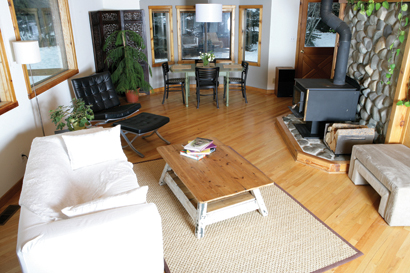
Lyle worked with the
environmentalist’s motto of reduce, reuse and recycle when furnishing
her new Hailey home. The coffee table is recycled (from the Gold Mine
Thrift Store in Ketchum), the dining room table is a hand-me-down from
her grandmother, and the wood stove, which originally did not fit well
with the home’s layout, was repositioned instead of thrown out. The
majority of the rest of the furniture is from Ikea. "They’re very
environmentally conscious," said Lyle. "They do a lot of low-VOC
products and good particle-board, reclaimed types of materials. The only
downside is the longevity, it’s not forever. But it was the best we
could afford and still be green."
Decorate
habitat
create an
eco-friendly habitat
writer:
Jennifer Tuohy
photographer: Chris Pilaro
Interior
designer Sarah Lyle was thrilled to be able to practice what she
preaches when she moved into her Hailey home last year. Her fledgling
company, White Canvas Designs, specializes in finding environmentally
conscious, green-aware materials for its clients.
So, she set about creating an eco-friendly habitat for herself and fiancé, Zach Latham. The work Lyle has done on her home and her plans for its future provide any aspiring green homeowner on a budget with a great starting point for the creation of a greener habitat.
"The most important thing to take into account when trying to achieve an eco-friendly home is each individual," said Lyle. "However lofty our goals are, we have to be realistic about them. We can’t expect to jump off the edge of our budget scheme and timeframe just to be green." However, there are many small steps to take to reach that green goal. Often, it is simply about making a choice.
"When we moved into this house, we wanted to make it our own straight-away. Repainting was the quickest way to do that," said Lyle. So they made a choice, selecting a low-VOC (volatile organic compound) paint.
"Almost all paint manufacturers have low-VOC or no-VOC options. Basically, it has to do with your air quality; choosing low-VOC paint immediately affects our health in a positive way. Also, there is not much of a difference price-wise, if any." Another simple change is lighting. "That is the next thing on our list; we’re really working on getting energy-efficient lighting."
Being on a budget when considering a home’s décor places some restrictions on how well the owner complies with environmentally beneficial practices. Here, planning ahead is the key. "The greenest thing you can do for your home is to replace your windows and doors," said Lyle. Ensuring the least amount of heat loss through properly fitting windows can dramatically reduce heating and cooling costs, as well as the negative impact that loss has on the environment. "Ideally, if we had the budget, we would use a window company that makes their frames/casements out of FSC-certified wood and use appropriate materials. But there’s a premium."
So, Lyle approached a local company for a bid to replace their windows. "The bid was very reasonable, but still out of our budget, so we might be replacing one window a year, but by replacing them, however long it takes, we’ll be cutting back tremendously on loss of heat."
In the meantime, Lyle takes small steps to offset the negative impact her windows and doors have on the environment. "Open your blinds during the day when it’s warm, to get the heat during the winter, and then close them at night to keep the heat in, and vice versa in the summer."
Considering the environment when undertaking big projects such as re-painting and replacing windows is paramount, but it is equally important to think green when furnishing a home. Here, it is not simply about buying something that claims to be environmentally friendly; in fact, sometimes it can be the opposite. "It’s also about reusing things," said Lyle. "With my clients, I constantly look at the opportunities to reuse what they already have. I always draw their existing furniture into the new house. Everyone’s got to get a new sofa at some point, and there’s nothing wrong with that. But, when you get that new sofa, that’s when it’s important to consider what is this sofa made of or what is the fabric on this sofa?" Furnishings that use organic fabric or 100 percent sustainable fabrics, such as cotton, linen, wool, silk, jute and hemp, are good options.
The most important thing is to get educated, said Lyle. "Look at the product, and ask yourself, where is it made? Is it made in China or in Idaho? If it’s made in Idaho, it’s probably a better choice, due to the energy expended to export goods. Then look at what it’s made of. If it doesn’t outwardly say where it’s from or how it’s manufactured or you can’t ask someone what goes into the materials, it’s likely not a good choice."
Three main areas to consider when selecting furniture for a home, are source, energy and life span:
Source:
Is it from a sustainable source or from a rapidly diminishing natural resource? "There are certain companies that specialize in green furniture—they source the frames for their sofas from certified wood companies, and their cushioning uses cotton polyester from socially responsible factories," said Lyle.Energy:
Consider the energy use required to produce and deliver the item. The less energy expended, the less strain is put on the planet’s resources. A prime example is carpet. "There is a chart that shows the highest production energy used for raw materials. Out of aluminum, lumber, plastics, glass and carpet, carpet was the second highest," said Lyle. This is due to the nylon in most carpets, which is manufactured using petroleum-based products. There are alternatives. Wool is an environmentally friendly product and Nylon 6.6 is another, newer green alternative. "Nylon 6.6 is a synthetic recycled nylon. A lot of major carpet companies are starting to use it, and it has the added bonus of being recyclable." Lyle recently worked on Ruscitto Latham Blanton’s remodel of The Community School in Sun Valley, where she specified a Nylon 6.6 carpet from Shaw. "At the end of that carpet’s life span, which Shaw says is 15 years, they will take it back and find a way to mill it."Life span:
How long before the product will need to be replaced and end up in a landfill? "Don’t buy an organic cotton chair if you know your dogs and kids will take it apart in a year," said Lyle. "It would be better to buy a leather chair that will last longer, even though it doesn’t outwardly say that it’s an environmentally friendly product. Sometimes the amount of use you will get out of something is more important than its other green credentials."In the past few years, manufacturers and retailers have started to provide eco-friendly products that either use recyclable materials or source from sustainable natural resources. Some of the now more commonly available green products include wallpaper, paint, lighting, carpets, flooring and furnishings. Most companies loudly proclaim their green credentials, but don’t take everything at face value. Do the research. In an effort to cash in on this exploding consumer market, some green products are being hyped dishonestly. Last November, environmental marketing watchdog Terra Choice released a report titled The Six Sins of Greenwashing (available online at terra choice.com), which claims many companies deliberately mislead the public about the environmental practices of that organization, from being vague to outright fibbing. Search Web sites such as usgbc.org, openco.org and buildinggreennc.com to help select the right green products. Secondly, look for the "ECO" logo and "Green Seal," which are independent certifications that a product is green.
One of the simplest, safest ways to be green is to shop locally. "If you buy furniture from a local store that is not FSC-certified wood, that’s OK, as they have location on their side," said Lyle. "It’s a balancing act. If you hit all three—source, energy and life span—that’s great, but two or even one is better than none."
A greener remodel
When planning a green remodel,
think "recycle" first and foremost.
Purchase repairable products, buy used products, saving them from
landfills, and check the Building Materials Thrift Store in Hailey. This
will help reduce manufacturing, fuel, shipping, packaging and disposal
expenses. Remember, every choice has environmental repercussions.
Another resource is Boise’s Green Foundations Building Center (greenfoundations.com). It sells green materials such as Skyblend (compressed wood) cabinets, paper stone counters, organic fabric and certified flooring. Green education lectures and a resource library are also on offer. Here in the valley, Englemann’s Resource Center (640 2nd Avenue South, Ketchum) has a display of eco-friendly building products that is open to the public.
Also, consider incorporating energy-saving elements into any structural remodel. Roof overhangs, overhead trellises and awnings save energy against a strong sun. Construct garages and sheds on the north side and place well-used rooms on the sunny side. Install windows to take advantage of cross ventilation.
The following tips and resources highlight some of the green elements to incorporate into any remodel.
Carpeting and flooring
"Environmental and décor television channels are bringing in more home-owners with green questions," said Beatrice Espinoza of Espinoza Flooring in Ketchum. Her suggestions: Opt for stone, cork, bamboo and eucalyptus materials, as these are more eco-friendly because of their abundance. Carpets made from 100 percent wool, sisal, jute and seagrass are also a good option.
Carpet tiles (flor.com) make partial carpet replacements easy.
Search for stain protections and adhesives free of harmful chemicals.
Lighting
Think skylights, including the easy-to-install, slinky-like sky tube that flexes from roof to room ceiling around attic obstacles. Glass blocks and interior windowless openings also boost passive lighting and reduce power bills.
Solar photocells and roof panels plus dusk-to-dawn exterior light photocells use the natural energy sources of sun and motion.
Install a smart Lutron Homeworks System. Craig Patterson of C & R Electric (candrelectric.com) suggests implementing this energy-saving program, citing the mid-valley’s Village Green housing project as a model. It is a room-by-room keypad system that automatically turns electric appliances, lights and heating on and off as programmed for energy-efficiency throughout the home, saving energy and money.
Install timers and wireless plug-in dimmers, an inexpensive remedy to control energy use.
Wood
Recycled wood: IGL Recycled Timbers in Carey carries seasoned, dried recycled and salvaged woods. "Our wood is generally rummaged from old buildings, a green source, and bears desirable historical defects," said owner Chris Gammon.
FSC Certified: "Look for the marking FSC on lumber. This is for the Forest Stewardship Council and certifies that it comes from green practices," said Marc Boudart, a licensed area green builder (environmentalbuild ingsolutions.com). Another stamp, the Sustainable Forest Initiative® Program, indicates lumber from certified forests.
Siding
HardiPlank: This longer-lasting, exterior fiber-cement board is straighter, heavier and more water-resistant than typical wood siding. It retains paint for approximately 10 years, much longer than traditional siding and is available at Stock Building Supply, Ketchum.
Insulation
Window coverings and solar screens (available at Sun Valley Shutters and Shades, Ketchum) plus window tinting (through SolarControl, Hailey) offer excellent ways to minimize heat loss and heat/cold infiltration.
For the walls, there are various insulation materials available that are more energy-efficient and eco-friendly than traditional fiberglass batting, according to Pat Buchanan of Anderson Insulation, Ketchum. Mineral wool and cotton batting or soy-based spray foam are good alternatives.
—Cornelia Russo